Cedar Park Elite Concrete works as a concrete contractor in Austin, TX, and there is one rule here that separates this city from every other jurisdiction we pour in. Past your property line, concrete work is not merely permitted work. It is licensed work, and a contractor without that license may not legally touch it at all.
More than 20 years in this trade has taught us that homeowners assume a driveway is a single job. In this city it is two. The part behind the line is one conversation; the apron, the curb, the gutter and the public walk are a different one, with a different filing, a different inspector and a different qualification behind the crew.
That distinction is not a formality, and it is not one a customer can waive. It is worth knowing before you take bids, because the cheapest number you receive may be from someone who is not permitted to do the part of the work you actually need. A crew that can pour a beautiful patio behind the house may have no standing whatsoever at the curb, and the two capabilities are genuinely unrelated.
Who May Work in the Right-of-Way
A License, Not Just a Permit
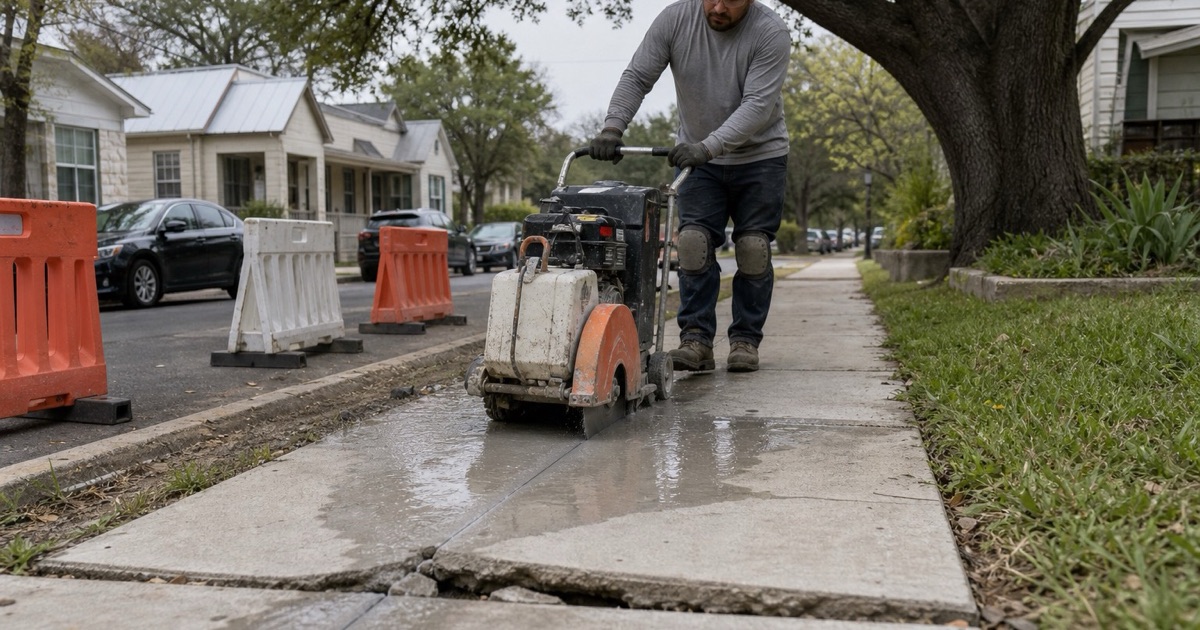
The Land Development Code requires a right-of-way construction license to construct, alter, remove or repair a sidewalk, curb, gutter, driveway approach or pedestrian way. That verb list is broad — repair is in it, so even patching an approach falls inside the requirement.
The license is personal to the holder and comes with obligations attached. It expires at the end of the calendar year, it cannot be transferred to anyone else, and the licensee must retain general supervision of the job rather than lending a credential to a crew working unsupervised. Annual expiry also means a license that was valid when you collected quotes may not be valid by the time work starts, which is worth confirming rather than assuming.
The Bond, and What Suspends the License
Licensing here is backed by money. The license requires a bond in an amount the city manager sets from the applicant’s project history and the potential damage to the right-of-way, and the driveway and sidewalk permit carries a $10,000 bond alongside insurance and the license itself.
The enforcement is automatic rather than discretionary. If the bond lapses, the license is suspended — not reviewed, suspended. That is worth understanding as a customer, because it means a contractor’s ability to finish your job can end mid-project through an administrative failure that has nothing to do with the concrete. We keep the bond and the insurance current as a standing obligation rather than renewing them job by job, because the consequence of a lapse falls on the customer’s schedule.
Subcontractors Are Named, and Licensed Too
The requirement reaches past the company on your invoice. Subcontractors who impact the right-of-way must be named on the permit and be licensed in their own right, so a licensed firm cannot subcontract the regulated portion to an unlicensed crew.
We mention it because it is the most common way the rule gets quietly broken. Asking who will actually be standing in the right-of-way, and whether that firm is named on the permit, is a fair question and a revealing one. The named-subcontractor rule exists precisely because the licensing requirement would otherwise be trivially easy to route around.
Looking for concrete-contractor closer to Serenada? See Serenada Concrete-Contractor.
The Permit, the Filing and the Inspections
A Permit Per Lot, and Who May File
The right-of-way construction permit is issued per lot or tract rather than per project, and only a licensed contractor may file for it. A homeowner cannot pull this one themselves and then hire labor against it, which is a meaningful difference from most permits people are used to.
Every driveway requires its own permit, with one exception: a semi-circular driveway is handled under a single permit. Where a building permit already exists for the property, the driveway and sidewalk permit is generated automatically and carries the same number. That per-lot structure occasionally surprises owners of corner properties or of a lot with two frontages, where the intuitive single application is not what the code contemplates.
Phase 1 and Phase 2 Inspections
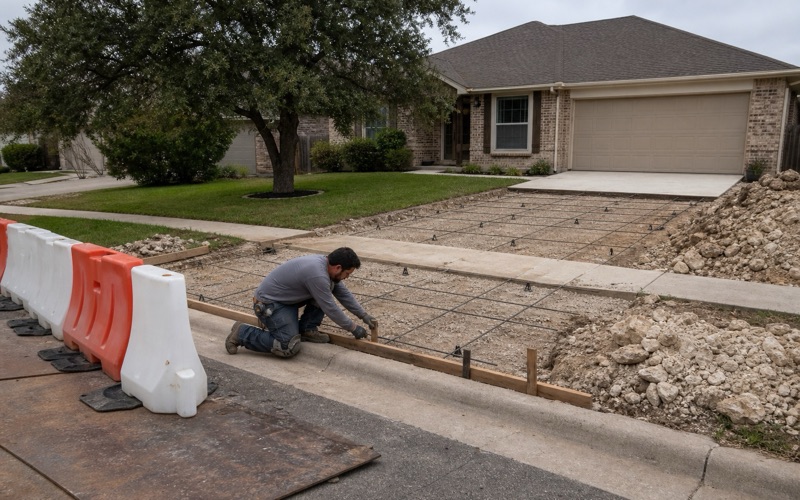
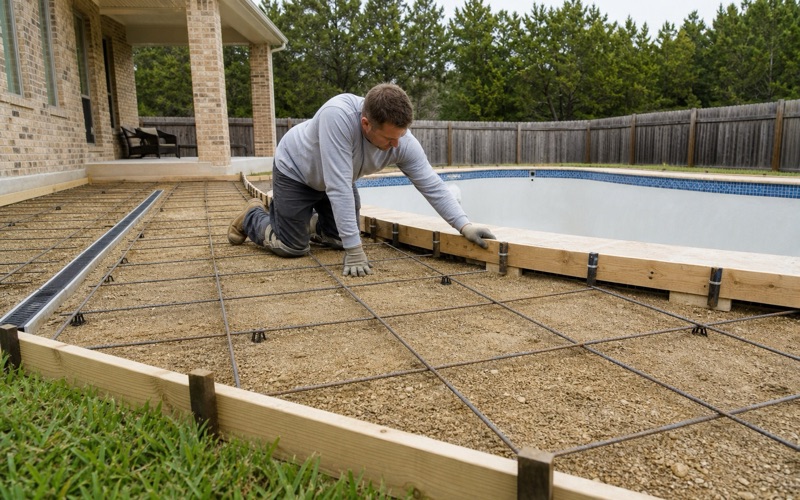
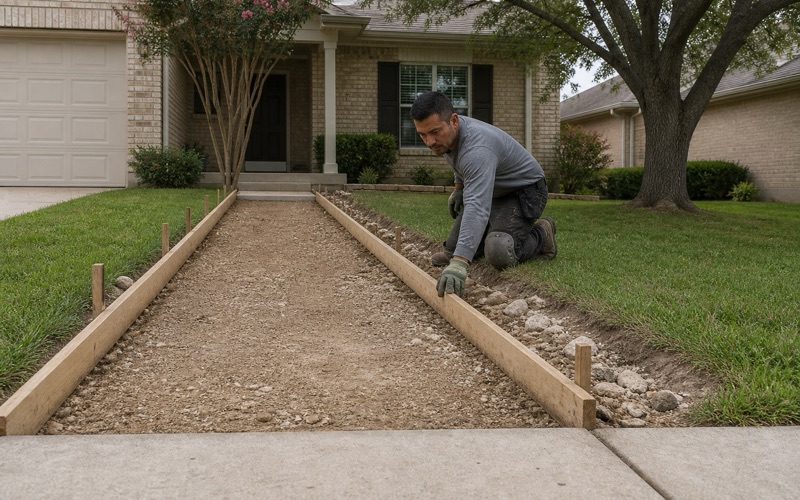
Inspection here is written into the code rather than left to practice. Section 25-6-297 requires a Phase 1 inspection covering line and grade, forms, reinforcing steel, drainage and subgrade before a final course of material is placed, and a Phase 2 final inspection that includes cleanup.
Phase 1 is a pre-pour inspection in everything but name, and it governs how a job is scheduled. Forms, steel and subgrade have to be complete and open to view, and they stay that way until the inspector has been. We build the pour date around that appointment rather than around a convenient morning. An inspector arriving to find steel already covered or forms half-struck costs a return visit, and the concrete waits either way.
When a Permit Is Revoked or Suspended
Two automatic consequences are worth knowing. The permit is automatically revoked if the applicant falsified or omitted required information, and automatically suspended if the work damages or interferes with utility equipment, a stormwater drainage facility, or a tree in a pedestrian way without the owner’s prior consent.
That last clause catches more jobs than people expect. Tree roots in a pedestrian way are common on older streets here, and a crew that treats a root as an obstacle rather than as a protected feature can stop its own permit. Establishing what is protected before the saw comes out is far cheaper than establishing it afterward with a suspended permit.
What the Code Specifies for Approaches and Walks
Type 1 and Type 2 Approaches
Driveway approaches are concrete by definition in this code. Section 25-6-2 defines a type 1 approach as a concrete driveway approach serving a one- or two-family residence, and a type 2 as a concrete approach serving anything else.
Those designations travel further than the city limits, because neighboring jurisdictions cite them by name in their own driveway standards. Knowing which type your frontage requires settles the mix, the section and the detailing in one step. It also means a detail drawn for one of them is not interchangeable with the other, and picking the wrong one is a rework conversation.
The Class A Mix and the Joint Detail
A residential Type I approach in the right-of-way is Class A concrete: 5.0 sacks of cement per cubic yard, 3,000 psi at 28 days and 2,100 psi at 7 days, a maximum water-cement ratio of 0.60, air entrained, placed over a two-inch minimum compacted cushion.
The jointing is specified as well — three-quarter-inch expansion joint material, full depth, where new work abuts existing, and weakened plane joints on 10-foot centers. A Type II approach takes the normal concrete pavement mix instead. None of this is a matter of house style; it is a spec we build to and can be measured against. Weakened plane joints on 10-foot centers is a tighter spacing than many crews default to, and it is not negotiable on this side of the line.
Public Sidewalk Reinforcement and Thickness
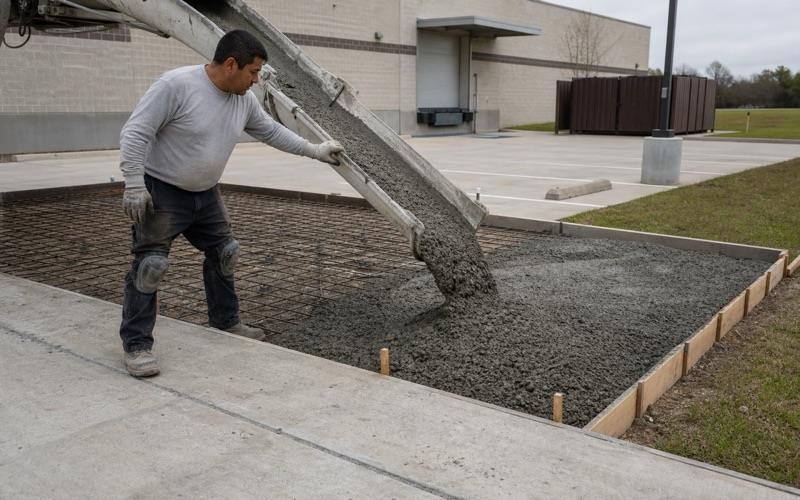
Public sidewalk is Class A or fibrous concrete on a two-to-five-inch granular cushion, with weakened plane joints at 5 feet on center cut one-quarter inch wide by three-quarters deep, and expansion joints at a maximum of 40 feet.
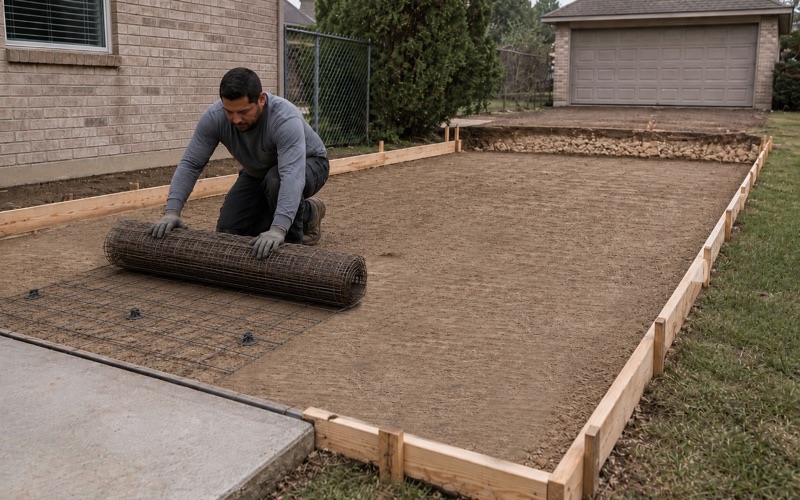
Reinforcement has three permitted forms: polypropylene fibrillated fibers, 6 by 6 W1.4 by W1.4 welded wire fabric, or a single layer of number 3 bars at no more than 18 inches on center both ways. Where steel is used it sits at slab mid-depth and never directly on the subgrade or the sand cushion. Thickness is a pay-item choice across 4, 5, 6 and 7 inches rather than a single figure, so it is a decision somebody has to make deliberately. Choosing among them is a real decision about cost, durability and how the walk will be maintained, rather than a detail to leave to whatever is on the truck.
Street Cuts, Recovery Costs and Warranty
The Moratorium Written as a Definition
There is a street-cut moratorium here and the word never appears in the code. It is written instead as the definition of a new street: 7 years for a collector or arterial and 5 years for a residential street or alley, applying to any stretch of at least 300 feet resurfaced with an inch and a half of hot mix, or joint to joint in concrete.
Excavating one of those requires the Director’s finding that no economical alternative route exists. We check the resurfacing history of your street before anyone plans around a cut, because that finding is not a formality and the answer is frequently no. Where the answer is no, the design has to reach your property without opening the pavement, and that constraint belongs at the start of a project rather than the middle.
Fiscal Security and Street Damage Recovery
Right-of-way excavation carries $10,000 of fiscal security posted before construction starts, plus a Street Damage Recovery Cost that varies street by street. That figure is published per street rather than set out in the manual, which means it has to be looked up for your address rather than estimated from a rate.
Quoting it properly is part of the job. A bid that omits the recovery cost is not cheaper — it is incomplete, and the difference lands on the owner. We look the figure up for the specific street rather than carrying a general allowance, so the number in front of you is the number the city will actually charge.
The Warranty You Are Owed
The code puts a warranty behind pavement repair: up to two years on the repair itself, with the owner warranting the backfill for the lifetime of the facility. Those are two different durations attached to two different parties, and knowing which is which matters if something settles later.
One further note for anyone comparing details across jurisdictions: the technical code stack here is not the usual Texas one. The mechanical and plumbing codes are the 2024 Uniform Mechanical Code and 2024 Uniform Plumbing Code published by IAPMO, alongside the 2024 building and residential codes, so a detail written to the International Plumbing Code does not automatically apply on this side of the line. There is a documented route to a non-standard detail as well: an alternative material, design or construction method may be approved by the director of the Public Works Department where it is found safe, durable and equivalent to the code and the Transportation Criteria Manual.
- 20+ Years Pouring Concrete
- Registered & Insured
- We Pour Our Own Jobs