Cedar Park Elite Concrete works as a concrete contractor in Brushy Creek, TX, and has been pouring and repairing flatwork in this part of Williamson County for more than 20 years. The single most useful thing we can tell a homeowner here is that the permit question on your project probably turns on a percentage rather than on the size of your lot.
That is because almost all of this place sits on the Edwards Aquifer recharge zone, the strictest of TCEQ’s three Edwards tiers. What follows from that is not a general concern about groundwater — it is a specific test your project either passes or does not, and it is measured in impervious cover rather than in lot size.
The practical consequence runs through everything on this page. Resurfacing the concrete you already have and adding new concrete are treated as different regulatory acts, and the difference is worth real money on an ordinary residential job. We work out which one your project is before we quote it, not after.
Why Replacing a Slab Here Is a Different Question From Resurfacing One
How much of the place is affected is measurable rather than approximate. Sampling the census place on a regular grid of 2,977 interior points against TCEQ’s official Edwards Aquifer layer returns 86.8 percent recharge zone and 13.2 percent contributing zone, and an independent grid of 2,441 points puts the recharge share at 86.6 percent. For most addresses here the recharge zone rules are the ones that apply.
Where TCEQ Draws the Line Around a Regulated Activity
TCEQ’s definition of a regulated activity reaches clearing, excavation and other work that alters or disturbs the topographic, geologic or existing recharge characteristics of a site. That is broad language and it is where most flatwork would land if the definition stopped there.
It does not stop there. The same definition expressly excludes the clearing of vegetation without soil disturbance, and the resurfacing of existing paved roads, parking lots, sidewalks and other development-related impervious surfaces. Resurfacing sits outside the regulated activity; new cover sits inside it.
Resurfacing, Overlays and Repair
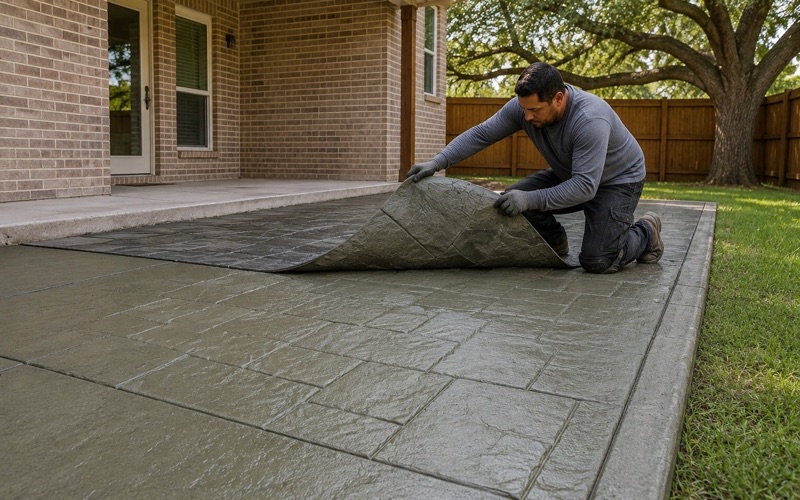
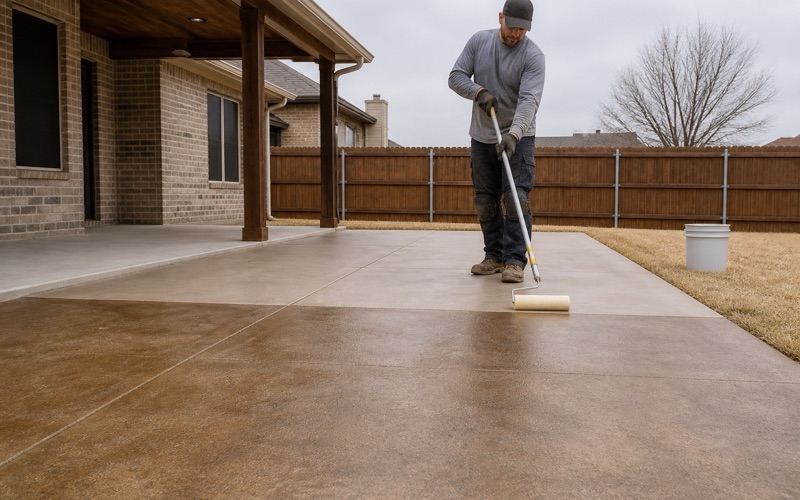
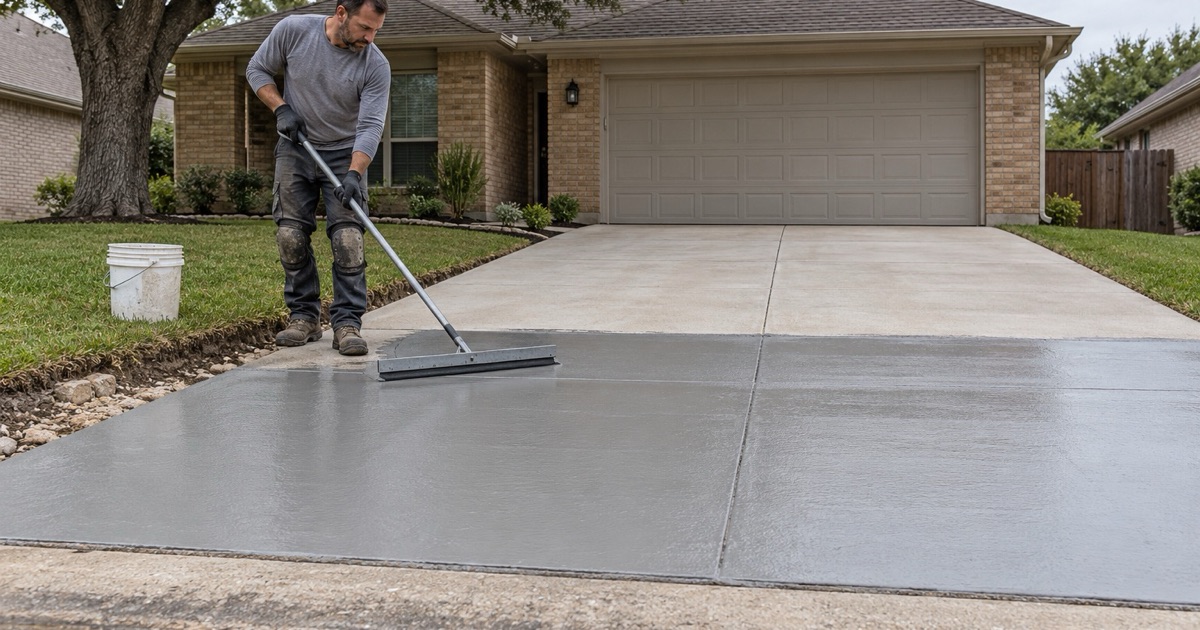
For a driveway or patio that is structurally sound but tired, an overlay or a microtopping gives you a new wearing surface on the slab that is already there. On this side of the line that route also avoids the regulatory question entirely, because the impervious surface already exists and is not being added to.
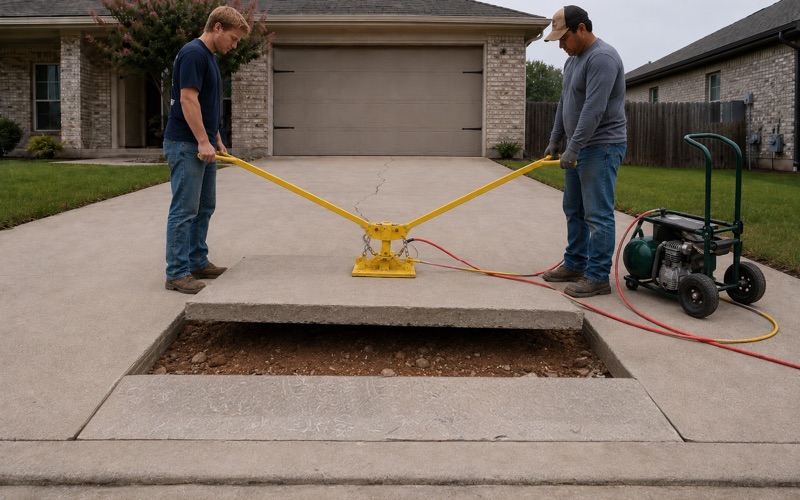
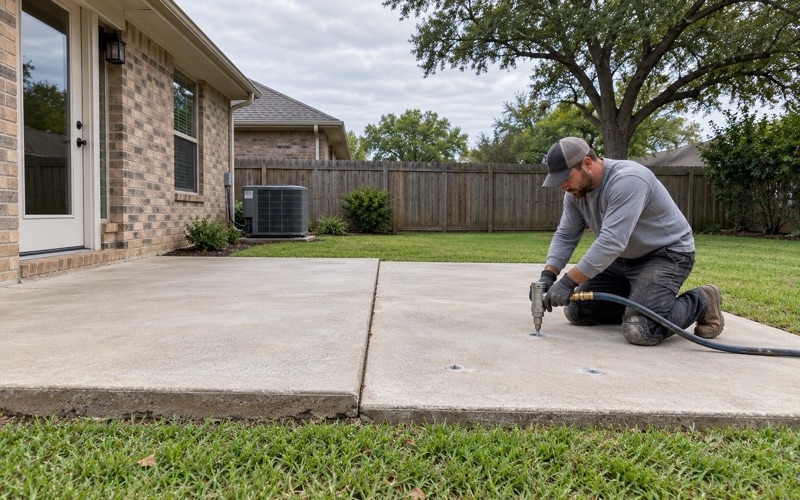
The same logic covers ordinary repair. Partial-depth repair at a spalled joint, full-depth repair of a broken panel, joint resealing and grinding out a trip hazard all work on concrete that is already down. We reach for those first here more often than we would somewhere the aquifer rules did not apply.
Replacement, and When It Pulls the Lot Back In
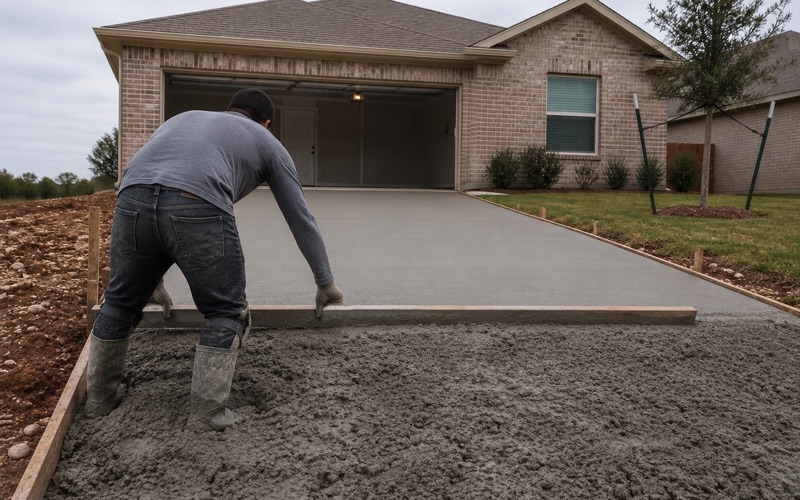
Replacing a slab in kind is one thing. Demolishing a previous development and building new single-family construction is another, and TCEQ’s guidance is explicit that the combination can pull a lot back into the regulated category even where each half looked exempt on its own.
That is a distinction people discover late and expensively. If your project is a replacement that quietly grows — a wider driveway, a bigger patio, a new pad along the way — we would rather flag it while it is still a drawing.
Looking for concrete-contractor closer to Leander? See Concrete-Contractor Services in Leander.
What Counts Toward Impervious Cover on a Single-Family Lot
The Test Is a Percentage, Not an Acreage
On the recharge zone the single-family exemption is an impervious-cover test, not an acreage test. TCEQ provides that a private residence needs no individual Edwards Aquifer protection plan if it is part of a master community with an approved plan, sits on a lot larger than five acres carrying no more than one residence, or does not exceed 20 percent impervious cover within the property’s legal boundaries.
For a typical lot here, the third route is the one that applies, and that means the arithmetic is the permit. There is no acreage floor on the recharge zone, so a small lot gets no relief from being small.
Rooftops, Driveways, Pads, Sheds and Sidewalks
The 20 percent test counts impervious cover expressly including rooftops, driveways, concrete pads, sheds and sidewalks. Flatwork counts. That is the sentence most quotes never mention, and it is why we measure what is already on your lot before pricing anything that adds to it.
It also means the order of your projects matters. A shed slab poured last year and a patio extension this year are the same number to TCEQ, and the second one is the one that finds the ceiling. A rainwater harvesting system can be used to bring adjusted impervious cover back to 20 percent or less, which is sometimes the difference between a project that proceeds and one that does not.
Where a Lot Straddles Two Zones
Roughly one lot in seven here sits on the contributing zone rather than the recharge zone, and some sites span both. Where that happens the rule is not proportional: regulated activities on a site located partly on the recharge zone and partly on the contributing zone must be treated as if the entire site sits on the recharge zone.
The stricter standard governs the whole of it. We check which zone a property is in before quoting rather than assuming from a neighboring address, because the boundary does not follow streets.
Working Over the Recharge Zone Without Adding Coverage
Filing Comes Before Starting
Where a project is a regulated activity, the sequence is fixed: no person may commence construction of a regulated activity until an Edwards Aquifer protection plan has been filed with the appropriate regional office, and reviewed and approved by the executive director. Work does not start and then catch up on paperwork.
That is worth knowing before you accept a start date from anyone. A contractor promising to break ground next week on a project that needs an approved plan is promising something they cannot deliver.
Erosion and Sedimentation Control, Even on Exempt Work
An exemption from the plan requirement is not an exemption from everything. Even exempted activity on the recharge zone has to install and maintain temporary erosion and sedimentation controls, and we build that into the job rather than treating it as an optional line.
A contractor working under an approved plan owes rather more: written notice to the TCEQ regional office no later than 48 hours before construction, the plans and approval letters kept on site and accessible to TCEQ personnel, protective barriers around sensitive features such as caves, sinkholes and wells before grading begins, a report of any spill of 25 gallons or more of gasoline or diesel, and written notice if a void larger than 6 inches in any direction is encountered.
Timelines and the Office That Handles It
Williamson County is administered from TCEQ’s Austin Regional Office, which since October 16, 2023 has handled all Edwards Aquifer applications and fees. Administrative review can take up to 30 days, and technical review of an administratively complete application up to 90 days.
Those are the numbers that should shape a schedule. A geologic assessment expires ten years after its original certification date, which occasionally means an older assessment on a property is still good and occasionally means it is not.
Permits Here Are County, Not City
There Is No Municipal Permit Office in Brushy Creek
Brushy Creek is a census designated place rather than a municipality, so there is no city hall, no municipal building department and no code of ordinances to consult. Anyone quoting you a city permit for flatwork here is describing an office that does not exist.
What replaces it is a county instrument. Williamson County issues a Certificate of Compliance for structures or other developments outside a floodplain in the unincorporated area. Where the property sits in a recorded subdivision, the plat notes may show a Defacto Certificate of Compliance was issued with the plat, in which case a separate application may not be required at all.
The County Driveway Permit and Its Inspection Sequence
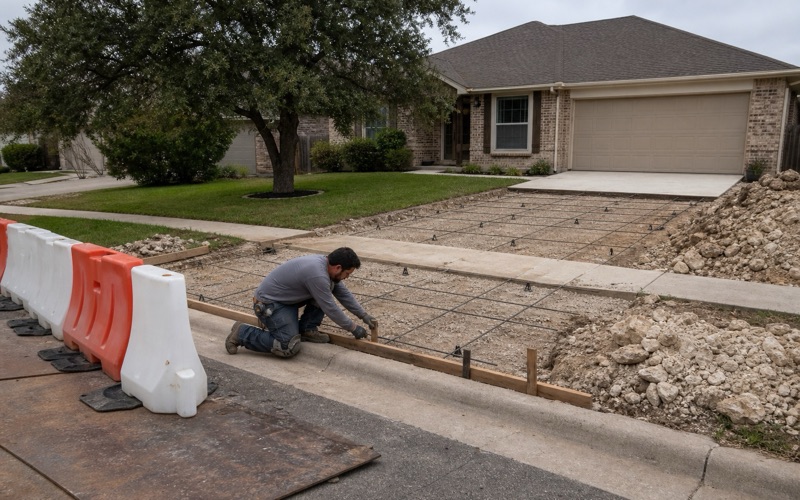
A driveway connecting to a county-maintained road is its own permit with its own inspections, handled by Williamson County Road & Bridge under a driveway policy adopted and effective December 7, 2021. No work may be undertaken in the right-of-way until a fully executed driveway permit has been received, and once approved you have a year to finish before reapplying.
The inspection sequence is written into the policy. On a resident residential application with a culvert, the county is called after the pipe is bedded to the correct slope and elevation and before backfill, again when forms are set and before concrete is placed, and again at completion. The driveway is only an authorized, permitted driveway once it has passed. We schedule those calls and wait for them.
Culverts, Widths and What the Policy Actually Caps
The policy provides four driveway types — straight tie-in, dip, culvert and curb-and-gutter — and the type required follows the drainage at your frontage rather than your preference. Culverts carry a specification the policy states twice: a minimum interior diameter of 18 inches, a minimum length of 24 feet, and concrete safety end treatments in accordance with current TxDOT standards.
Residential dimensions are capped as well. Maximum width is 24 feet, suggested maximum change in grade 15 percent, and minimum radius 15 feet with a pipe culvert, dropping to a 10-foot radius for a dip or straight tie-in inside a subdivision and 5 feet for curb-and-gutter. Residential surface material is left to the applicant with an all-weather surface recommended, while commercial, industrial and multifamily driveways must be concrete or asphalt.
One detail worth knowing before you budget: the 31-page county driveway policy states no permit fee at all. In a place of roughly 22,500 people where nearly three-quarters of the 7,027 occupied housing units are owner-occupied, that is a lot of driveways whose owners are being quoted for a fee that the policy does not levy.
- 20+ Years Pouring Concrete
- Registered & Insured
- We Pour Our Own Jobs