Cedar Park Elite Concrete works as a concrete contractor in Burnet, TX, and this town sits on a geological boundary that shows up directly in a quote. The eastern side is shallow soil over limestone; a small western portion is soil formed from granite and gneiss, and the two behave nothing alike under a slab.
More than 20 years of pouring across this region has taught us that a base recipe carried across town is the most common way a good crew produces a bad result. Here that is not a subtlety — the drainage rates differ by an order of magnitude, and a base built for one condition is genuinely wrong for the other. The two sides of this town are closer to being different regions than different neighborhoods, as far as a slab is concerned.
The second thing to know before pricing anything is administrative. This city removed the model residential code’s provision covering sidewalks and driveways, which puts flatwork inside the permit system rather than outside it.
Two Subgrades, and Why the Address Decides the Base
The Limestone Majority
Clipped to the city polygon, 84.0 percent of the named soil components formed in limestone, chalk or marl. That is the dominant condition and it is a shallow one: 47.1 percent of components carry indurated bedrock and 27.1 percent carry weakly or moderately coherent bedrock, leaving only 18.7 percent with no restriction recorded at all.
The single largest map unit is the Eckrant-Rock outcrop association on 1 to 10 percent slopes, covering 26.86 percent of the city at 58 percent Eckrant and 16 percent bare rock outcrop. Eckrant puts hard limestone at a representative 28 centimeters, roughly 11 inches, and mapped bare rock outcrop totals 4.9 percent of the city surface. Sixteen percent bare rock outcrop means that on roughly one point in six there is no soil profile at all above the bedrock.
The Granitic West Side
The granitic soils are real, they are on the west side, and they are a small minority. The Voca-Click association covers 1.76 percent of the city and the Keese-Rock outcrop complex 1.91 percent, with those components formed in material weathered from granite and gneiss while every other major unit in the city formed over limestone.
They behave nothing like their neighbors. Click is 7 percent clay at a plasticity index of 3 in its surface horizon, with saturated hydraulic conductivity of 28 to 92 micrometers per second and bedrock only at 137 centimeters. Voca is 14 percent clay at a plasticity index of 9 at the surface but 48 percent clay at a plasticity index of 34 from 20 to 71 centimeters, with no bedrock restriction recorded at all. Ninety-two micrometers per second is extremely permeable material by any standard applied in this region.
What That Means for a Quote
A subgrade recipe written for the east side of town is the wrong recipe on the west side, and the reverse is equally true. One is a thin, fast-draining profile over hard rock; the other is a deep, extremely permeable profile with a heavier layer partway down.
We establish which condition applies to the specific property before pricing, because it changes the excavation, the base and the drainage design together. It is a lookup rather than an investigation, and skipping it is how a number arrives confidently and wrongly. A neighbor’s experience two streets away is not evidence about your lot when the boundary between the two conditions runs through the town.
Looking for concrete-contractor closer to Brushy Creek? See Concrete-Contractor in Brushy Creek.
Reading the Numbers in Pairs
Eckrant, Where One Figure Misleads
Eckrant is the clearest case in this town of why a single measurement is not enough. Its surface horizons run 42 to 45 percent clay at a plasticity index of 32 and a liquid limit of 60, which is high plasticity by any reading and would ordinarily call for a defensive design.
Its linear extensibility is only 2.7 to 3.7 percent. The failure to expect on an Eckrant lot is bearing on shallow rock under thin cover, not seasonal heave, and building heavily against movement there spends money on the wrong risk entirely. Getting that judgment right is the difference between a slab specified for the problem it has and one specified for a problem it does not.
Sharp Internal Contrasts
Hensley gravelly loam covers 13.8 percent of the city and carries a sharp contrast inside a very short depth: 22 percent clay at a plasticity index of 14 in the top 13 centimeters, then 45 percent clay at a plasticity index of 32 from 13 to 46 centimeters, with saturated hydraulic conductivity falling from 9 to 0.91 micrometers per second across that boundary.
That is a support and drainage change inside the first eighteen inches. A shallow look tells you about the top layer and nothing about the one a slab will actually rest on, which is why we open the ground to a useful depth rather than a convenient one. Excavating to a depth that actually reaches the bearing layer costs very little more than a shallow check and answers a different question entirely.
The Soft-Rock Units
The Brackett association covers 10.72 percent of the city at 87 percent Brackett — weakly coherent bedrock at a representative 36 centimeters under 28 to 30 percent clay at a plasticity index of 11 to 14, with linear extensibility of 2.4 to 2.6 percent, 60 percent calcium carbonate and conductivity of 9 micrometers per second.
That is soft, rippable material under a thin, low-plasticity, fast-draining loam, and it is comparatively straightforward ground to work. Bolar clay loam covers 10.34 percent with hard limestone at 71 centimeters at a plasticity index of 17 to 18, and Doss silty clay 7.88 percent with softer bedrock at 43 centimeters at a plasticity index of 27 to 29. On those units the excavation line in a bid is far more predictable, which is worth saying when it is true.
The Minority That Genuinely Moves
The deep, moving soils here are a minority and they are identifiable by name. Krum clay covers 5.0 percent of the city with no bedrock restriction, 45 to 50 percent clay, a plasticity index of 31 to 34 and linear extensibility of 7.0 to 10.3 percent.
Anhalt clay covers 1.26 percent at 71 percent clay in its subsoil, a plasticity index of 56, a liquid limit of 85 and linear extensibility of 15.9 to 16.1 percent. Vertisols are only 2.5 percent of the city’s named components overall, so ground that genuinely moves is the exception here rather than the rule — but on those lots it is the whole design problem. Identifying those lots matters precisely because the surrounding advice does not apply to them.
The Permit the City Requires for Flatwork
What This City Changed
The model residential code carries a provision covering sidewalks and driveways below a stated height above adjacent grade. This city removed it, which means that flatwork sits inside the permit system here rather than outside it.
That is a deliberate choice by a city rather than an oversight, and it changes what a homeowner should expect. A driveway replacement here involves an application, and a contractor who does not raise that has either not worked in town or is not planning to file one. We would rather an owner hear that from us at quoting time than from a neighbor after the concrete is down.
Why It Is Worth Having
Permitted work leaves a record attached to the property, which is worth something when a house is sold and worth more if a question is ever raised about what was built. It also puts a floor under the work, because a job that has to be described on an application is a job somebody has thought about in advance.
We build the application into the schedule rather than treating it as an afterthought, and we would rather quote a realistic date that includes it than a flattering one that does not.
Preparing a Base on Ground That Drains Differently
Fast-Draining Ground Needs a Different Answer
Where conductivity runs as high as 92 micrometers per second, water leaves the profile almost immediately, and the design question shifts from getting water away to keeping the base stable and confined. Fines migrate in very permeable material, and a base that loses its fines loses its support.
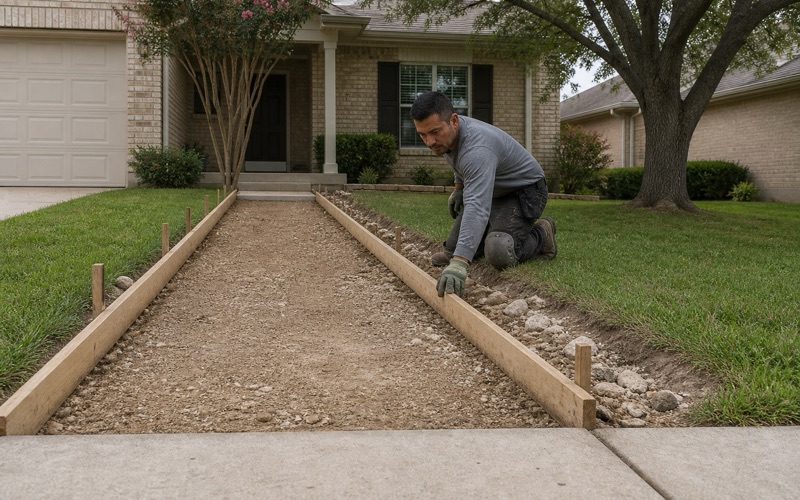
That is a compaction and gradation question rather than a drainage one, and it wants a different specification from the same slab built on the eastern side of town. We specify the base material and its compaction against the ground it is going onto rather than carrying one detail across the whole town.
Thin Cover Over Rock Needs Another
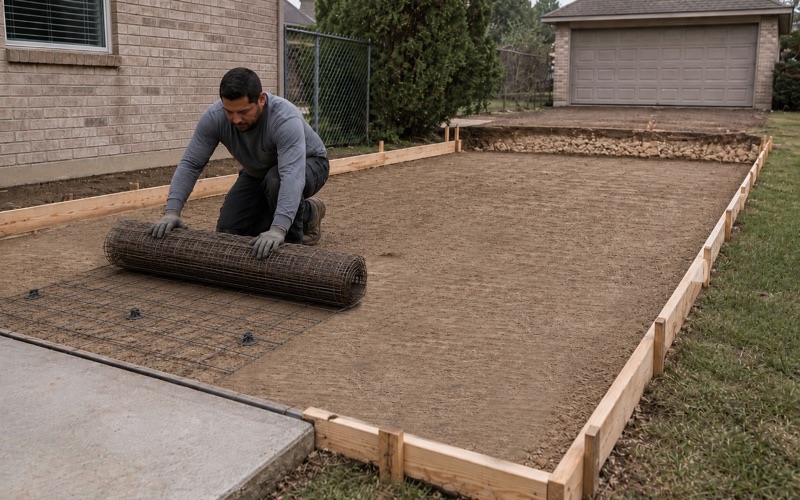
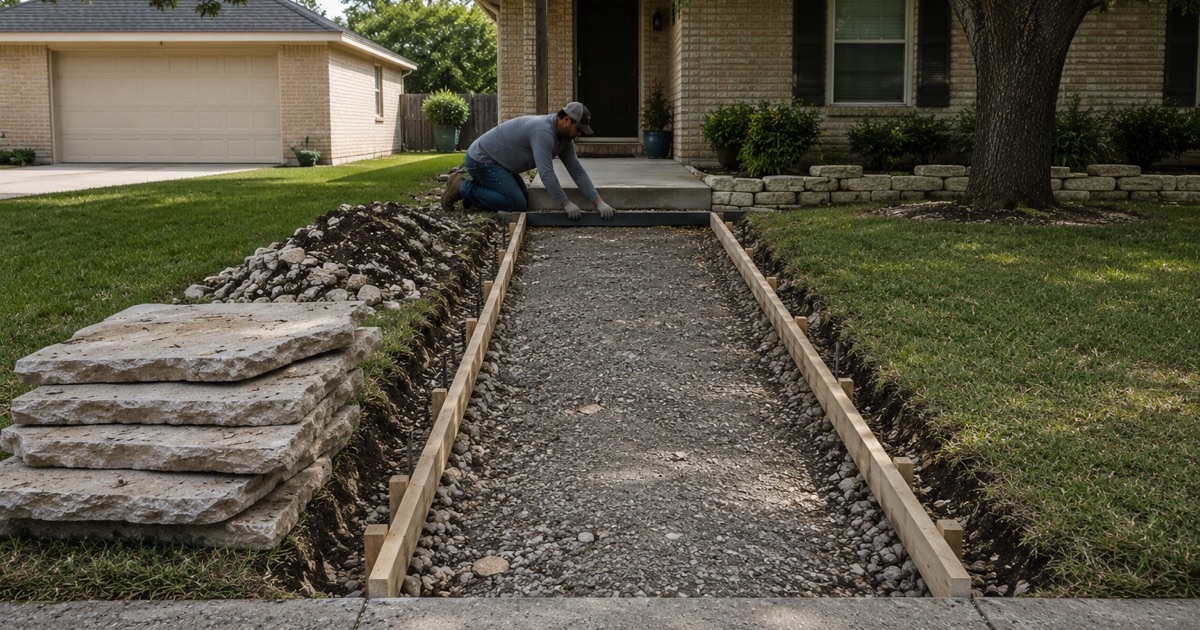
On the shallow limestone units the opposite applies. There is little profile to work with, water moves sideways along the rock rather than down through it, and the bearing surface is frequently rock that has to be cleaned and prepared rather than compacted.
Getting a uniform bearing condition is the goal in both cases and the method is entirely different. On a lot with rock rising and falling under a slab, leveling the bearing surface deliberately rather than following the rock is what keeps the finished work flat.
Bottomland and Occasional Flooding
One more unit is worth naming because it turns up on lower ground. Oakalla silty clay loam covers 5.2 percent of the city as an occasionally flooded bottomland unit, at 30 to 34 percent clay with a plasticity index of 16 to 24 and linear extensibility of 2.2 to 3.2 percent, well drained with conductivity of 9 micrometers per second.
Occasional flooding is a mapped condition rather than a rare event on that ground, and it changes where a slab should sit and how it should be edged. We check for it before setting a finished level rather than matching whatever the neighboring slab happens to be.
- 20+ Years Pouring Concrete
- Registered & Insured
- We Pour Our Own Jobs