
Cedar Park Elite Concrete has been doing concrete leveling in Cedar Park, TX for more than 20 years, serving surrounding cities including Brushy Creek, Leander, Hudson Bend, Round Rock and Wells Branch. Leveling means lifting a slab that has dropped back to the elevation it was poured at, rather than breaking it out and starting over. We do it on driveways, garage floors, walkways, patios, pool decks, warehouse floors and equipment pads.
We quote leveling against replacement with real numbers and tell you which one your slab actually needs. Lifting a slab that is still sound costs a fraction of tearing it out, and a great deal of the flatwork we look at is sound — it has moved, which is a different problem from being broken. When the concrete itself has failed, we say so instead of selling a lift that buys a year.
What we work out first is why it moved, because the void under a slab is the actual defect and filling it without understanding it is temporary. The ground on this side of the county changes from deep clay to rock close enough to the surface that the excavation becomes the job, and those two conditions fail in opposite ways. Nearly every slab poured here since the 1990s is post-tensioned, so we locate tendons before drilling a single injection port.
Why Concrete Settles on This Side of Williamson County
Deep Clay, Potential Vertical Rise and Seasonal Movement
Where the lot sits on deep clay, the soil changes volume with moisture. Potential vertical rise is the measurement that describes how far a given soil profile can lift and drop through a wet-to-dry cycle, and on a driveway it shows up as one panel standing proud of the next by the end of a dry summer. Movement like that is seasonal, so we want to know where the slab sits in that cycle before setting a target elevation.
That is also why we ask how long the offset has been there and whether it comes and goes. A panel that rocks in August and sits flat in March is telling us something different from one that dropped and stayed down.
Shallow Limestone, Caliche and Uneven Bearing
Elsewhere in the same city the rock is close enough to the surface that the original crew hit indurated limestone and filled over it rather than paying for limestone rock excavation. The slab then bears on rock at one end and on fill at the other, and only the fill end settles. Caliche behaves the same way when it gets used as a leveling course and never sees proper compaction.
We probe before we price. Knowing whether the low corner sits on a few inches of fill or several feet of it changes both the volume of material the lift will take and whether the lift will hold.
Subgrade Compaction and Washed-Out Flexible Base
The third cause is water, and it is the most common one on newer flatwork. A downspout discharging at the edge of a driveway, an irrigation line that has been weeping for a season, or an approach backfilled loose will all carry fines out from under the concrete. Subgrade compaction that was never done properly, or a flexible base laid thin, gives that water somewhere to go.
Filling the void without addressing the water means we will both be back. We say where the water is coming from and what needs to change, even when that part of the work is not ours to do.
Concrete Leveling Methods We Use
Polyurethane Foam Injection for Driveways, Walks and Pool Decks
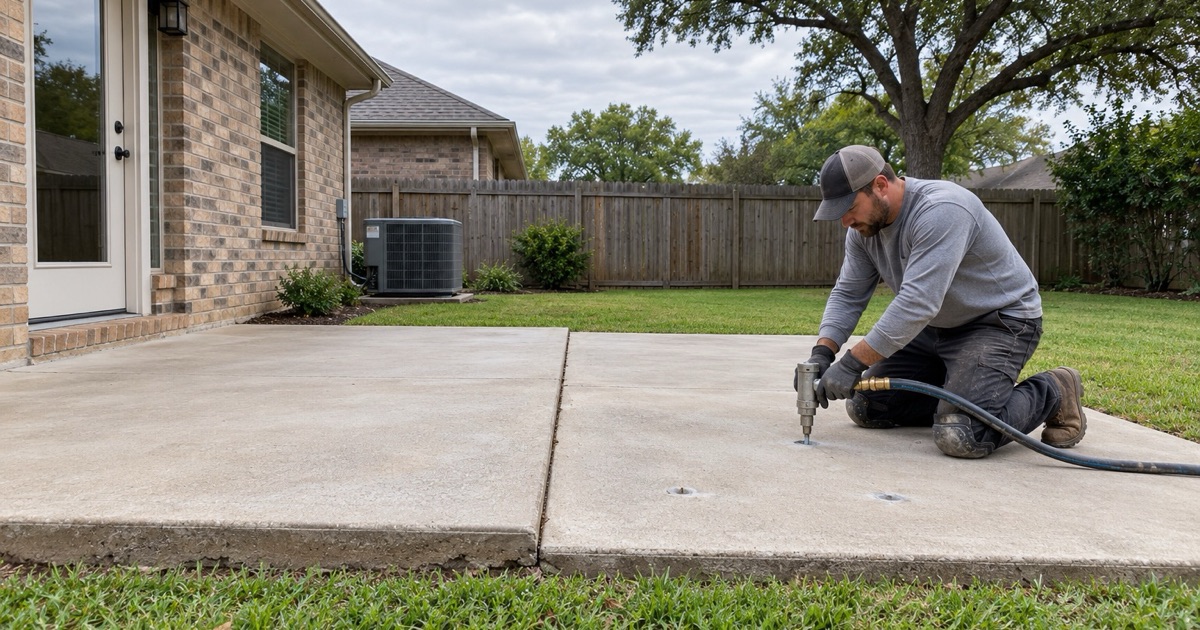
Polyurethane foam injection is our default on residential flatwork. We drill small ports through the slab, inject a two-part foam that expands underneath it, and watch the panel come up against a laser. The foam is light, so it does not load the same soft ground that let the slab drop in the first place, and it is unaffected by moisture once it has set.
It also sets fast. The foam reaches most of its strength within minutes, so a driveway lifted in the morning is usually back in service the same day rather than sitting behind cones for a week.
Slabjacking and Mudjacking for Heavy Flatwork and Pads
Slabjacking with a cementitious grout — mudjacking, in the older name — still earns its place under heavy slabs where added weight is not a liability and material cost matters. Warehouse floors, loading aprons, housekeeping pads, generator pads and transformer pads are the usual candidates. The ports are larger and the cure is slower, and we tell you which method we are proposing and why rather than leaving it as a line on the invoice.
Diamond Grinding When Lifting Is the Wrong Answer
Not every offset should be lifted. Where a walkway has a trip hazard at one joint and the slab either side is sound and stable, diamond grinding takes the lip off in an afternoon with no drilling at all. On a public walk the surface also has to satisfy the change-in-level limits in PROWAG and the Texas Accessibility Standards, which a ground joint meets cleanly and an overshot lift does not.
Leveling a Post-Tensioned Slab Without Cutting a Tendon
Locating Unbonded Single Strand Tendons Before We Drill
A post-tensioned slab-on-ground holds its shape because unbonded single strand tendons are stressed across it. Drilling a port through one is not a small mistake — it releases the strand along its whole length, and putting that right is a specialty repair. We scan and mark the tendon layout before any port goes in, and we drill between strands rather than where we assume they are not.
PTI DC10.1 is the design standard those slabs are built to, and it is also what tells you roughly how the tendon spacing ought to look. We use it as a check on what the scan shows, never as a substitute for scanning.
Void Form, Carton Form and What the Slab Was Built to Do
Some structural slabs here were poured over void form or carton form deliberately — a crushable layer that gives expansive clay somewhere to swell into without lifting the building. A gap under that kind of slab is not a defect, and pumping it full of foam works directly against the design. Reading the slab correctly before injecting anything is the difference between a repair and an expensive mistake.
Injection Ports, the Vapor Retarder and What Sits Underneath
Below a conditioned slab there is usually a vapor retarder, and on anything built to ASTM E1745 that sheet is worth not perforating carelessly. Plumbing, conduit and post-tension anchors all live in the same few inches of concrete and fill. We plan the port pattern around what is actually down there, and every port gets patched when the lift is finished.
Concrete Leveling or Replacement — How We Price the Choice
The Numbers We Put Side by Side
When we quote, you get both routes priced: what it costs to lift and seal what you have, and what it costs to demolish, haul off, rebuild the subgrade and pour new. That comparison is the entire decision, and for a sound slab it is not close. Seeing both numbers is also what tells you whether the lift is worth doing at all, which is not something you can judge from one figure.
Slabs We Tell You to Replace Instead
A slab spalling across its surface, cracked into more pieces than it has joints, or sitting on a subgrade that has washed out entirely is not a leveling candidate. Lifting it holds the pieces at the new elevation for a while, and then they carry on moving independently. Partial-depth repair or full-depth repair sometimes bridges that gap and we will price it, but we do not lift concrete that has run out of structure.
Permits, Impervious Cover and When Replacement Changes the Paperwork
Leveling adds no impervious cover, which keeps it clear of the state limit that caps a single family lot over the aquifer at twenty percent counting rooftops, driveways, concrete pads, sheds and sidewalks. Replacing in the same footprint usually does too. Enlarging the slab is where that changes: we check whether the lot sits over the Edwards Aquifer contributing or recharge zone before quoting new flatwork, because state approval has to come before the city will issue a site development permit.
Cedar Park leaves residential driveways and sidewalks permit exempt, and we say so up front instead of billing you for a permit the city does not require. A driveway approach is the exception, because it crosses into public right-of-way and gets inspected before any concrete goes down.
Joint Resealing and Sealing After the Lift
A lift is finished at the joints. Control joints, expansion joints and isolation joints that opened while the slab was down get cleaned and resealed, and the ports are patched to match the surrounding finish. Where the surface is worth protecting we will put a penetrating sealer on it, and on a garage or shop floor a densifier is usually the better spend.
- 20+ Years Pouring Concrete
- Registered & Insured
- We Pour Our Own Jobs