
Cedar Park Elite Concrete pours concrete slabs and pads in Cedar Park, TX and has done for more than 20 years, serving surrounding cities including Brushy Creek, Leander, Hudson Bend, Round Rock and Wells Branch. Slabs are the least forgiving work we do, because everything that decides whether one lasts is buried before the concrete arrives.
A finish can be redone and a crack can be repaired. What sits under the slab cannot be reached again without breaking the slab, which is why we spend the time on subgrade, reinforcement and moisture control that a quote-by-square-foot contractor skips. It is also why our number sometimes arrives higher and stays where it started.
We find out what your slab will sit on before we price it. The ground on this side of the county shifts from deep clay to rock close enough to the surface that the excavation turns into the job, and a pad quoted without anyone looking at that is a pad quoted twice.
Residential Concrete Slabs and Pads
Garage, Shop and Room Addition Slabs
An attached addition and a detached shop are different structural problems even when the concrete looks identical. The addition has to be isolated from the house so the two can move independently without dragging each other, and the shop gets designed around what will roll across it — a lift, a trailer or a tractor changes the slab, not just the price.
Shed, Hot Tub and Equipment Pads
Small pads are where corners get cut most often, usually because the job is too small to feel worth doing properly. A hot tub pad carries a concentrated load that never moves; a shed pad has to shed water away from the building it supports. Both want the same compaction and jointing discipline as a large slab, on a smaller footprint.
Small pours also carry their own economics. A single pad will often trigger a ready-mix short load fee, and where access is tight a concrete pump truck may be the difference between a clean pour and wheelbarrows across your lawn. We put both in the quote instead of discovering them on the day.
RV, Boat and Vehicle Parking Pads
A parking pad for anything heavier than a car is a structural slab wearing casual clothes. Loaded axle weight, tongue jacks and stabilizers all bear on small areas, and the slab gets thickness, reinforcement and a subgrade built for that rather than for foot traffic. We ask what is actually going to sit there, including the thing you plan to buy next.
Commercial Concrete Slabs and Pads
Housekeeping Pads, Generator Pads and Transformer Pads
Equipment pads answer to the equipment. A housekeeping pad raises a unit clear of washdown and gives you a clean edge to work to; a generator pad or transformer pad has anchor patterns, conduit stub-ups and clearances that are set by the manufacturer and the utility rather than by us. We build from the shop drawing and we confirm the anchor layout before the pour rather than after.
Loading, Dumpster and Service Yard Pads
Pads that take a truck take abuse in a very specific way: turning wheels, dropped forks and repeated point loading at the same spot. A dumpster pad in particular gets hammered where the truck’s rollers land, so the slab, the reinforcement and the approach into it get built as one thing rather than as a pad with an apron added later.
Warehouse and Light Industrial Floor Slabs
Interior floor slabs bring flatness, joint layout and load transfer into the conversation. Dowel baskets at construction joints let adjacent panels carry load across the joint instead of curling independently, which is what keeps forklift traffic from beating the joint edges apart. Where a floor will be coated later, we finish it to suit the coating rather than to suit ourselves.
What Goes Under a Slab in This Part of Williamson County
Subgrade Compaction, Flexible Base and Rock Excavation
Uniform support beats strong support. A slab bearing on indurated limestone at one end and loose fill at the other cracks at the change no matter what the mix ticket says, so where rock comes up near the surface we price limestone rock excavation honestly instead of filling over it. Where the clay runs deep, compaction and a properly placed flexible base do the work.
Caliche is common as a base material here and behaves well when it is compacted in lifts and badly when it is dumped and graded. Which one happened on your site is usually visible once we open it up.
Vapor Retarder and Moisture Control
Under a conditioned or coated slab, a vapor retarder meeting ASTM E1745 is not an optional extra — it is the reason a floor covering installed years later still bonds. Placement matters as much as the sheet: laps sealed, penetrations detailed, and the material protected from the crew rather than shredded before the pour.
Void Form, Carton Form and Expansive Clay
Where the design calls for it, void form or carton form goes under a structural slab to give expansive clay somewhere to swell without lifting the structure. That is a design decision made by an engineer, and our job is to install it as drawn and to recognize it later so that nobody mistakes the intentional gap underneath for a settlement void.
Reinforcement, Jointing and Curing
Welded Wire Reinforcement, Rebar and Dowel Baskets
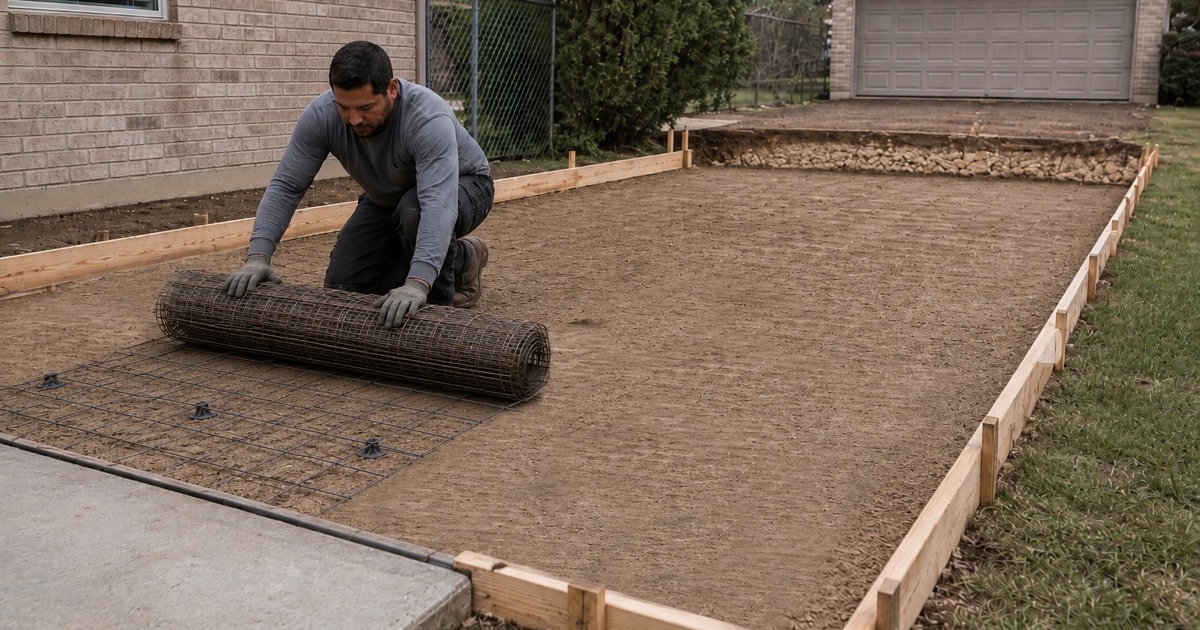
Steel does nothing where it sits on the ground. Welded wire reinforcement and rebar get set on chairs at the specified height and stay there through the pour, and dowel baskets go in where load has to cross a joint. Fiber mesh controls shrinkage in the surface and is not a replacement for either.
Post-Tensioned Slab-on-Ground and What It Means Later
Nearly every slab poured here since the 1990s is post-tensioned, so we locate tendons before we cut, core or anchor anything through one — which comes up more often on pads than people expect, because bolting equipment down means drilling. PTI DC10.1 is the standard those slabs are designed to, and scanning is what we actually trust on site.
Control Joints, Curing and Pouring in Summer
Jointing decides where a slab cracks, so sawcut control joints go in on a planned layout and in the window where they relieve stress rather than follow it. Curing is protected with a curing compound rather than left to the weather. Summer pours are scheduled around the concrete’s own temperature, because the state highway spec starts the discharge clock once the mix reaches ninety degrees.
- 20+ Years Pouring Concrete
- Registered & Insured
- We Pour Our Own Jobs