Cedar Park Elite Concrete works as a concrete contractor in Elgin, TX, and this city has a trap in it that catches experienced crews. The ground here looks sandy when you open it, drains like sand for the first spade depth, and then turns into heavy clay a few inches down.
More than 20 years of pouring across this region has taught us that a shallow excavation is the standard way people form an opinion about a site. Here that opinion is wrong nearly half the time, because the material a slab will actually bear on is not the material anyone sees at the surface.
The consequence shows up later rather than immediately. A base built on the assumption of free-draining ground, over a layer that is neither free-draining nor stable, is a base that performs well for a season and then stops performing at all. That delay is what makes the mistake so common, because the crew that made it is long gone before the evidence appears.
Why the Ground Looks Sandy and Behaves Like Clay
Two Soil Orders, Side by Side
The city is close to evenly divided between Alfisols at 47.7 percent and Vertisols at 40.6 percent. Those two behave very differently under a slab and they sit next to each other inside the city limits rather than in separate districts, so a job on one street can be a different problem from a job on the next.
There is a further complication worth stating plainly. The city limits straddle a county line and a soil survey boundary, with 67.2 percent of the mapped area in the Bastrop County survey and 32.8 percent in the Travis County survey, so any soil figure quoted for this city has to say which survey it came from — the western part of the city is not in the Bastrop survey at all. We note which survey a figure came from when we discuss it, because a number quoted without that context can be simply inapplicable to a given lot.
The Sandy Half Is the Trap
Crockett fine sandy loam covers 16.65 percent of the city across two map units. Its surface horizon, from 0 to 20 centimeters, is 13 percent clay at a plasticity index of 11 with saturated hydraulic conductivity of 28 micrometers per second — genuinely sandy, genuinely fast-draining material that behaves exactly as it looks.
The horizon immediately below it, from 20 to 63 centimeters, is 46 percent clay at a plasticity index of 38 and a liquid limit of 62, with linear extensibility of 9.0 percent and conductivity dropping to 0.91. That is a 27-point jump in plasticity index and a roughly thirtyfold collapse in permeability at about eight inches down, which is well inside the depth any slab cares about. Nothing about the surface gives any warning of it, which is why the depth of a test matters more here than the number of tests.
Edge Repeats It Harder
Edge fine sandy loam covers a further 14.55 percent of the city and does the same thing more sharply. Its surface horizon is 8.5 percent clay at a plasticity index of 4 with conductivity of 28 micrometers per second, and the horizon at 28 to 30 centimeters is 47.5 percent clay at a plasticity index of 36 with conductivity of 0.91.
That is a 32-point plasticity jump and a thirtyfold conductivity drop at roughly twelve inches. A shallow excavation that stays inside the sandy cap tells you nothing whatever about the material a slab will bear on, which is exactly why we dig past it before pricing anything with depth in it. On Edge the transition can sit under a single spade depth, so even a careful visual check at the surface is not enough to price the work.
Looking for concrete-contractor closer to Buda? See Concrete-Contractor Services in Buda.
The Permeability Collapse Under the Topsoil
What It Does to Drainage
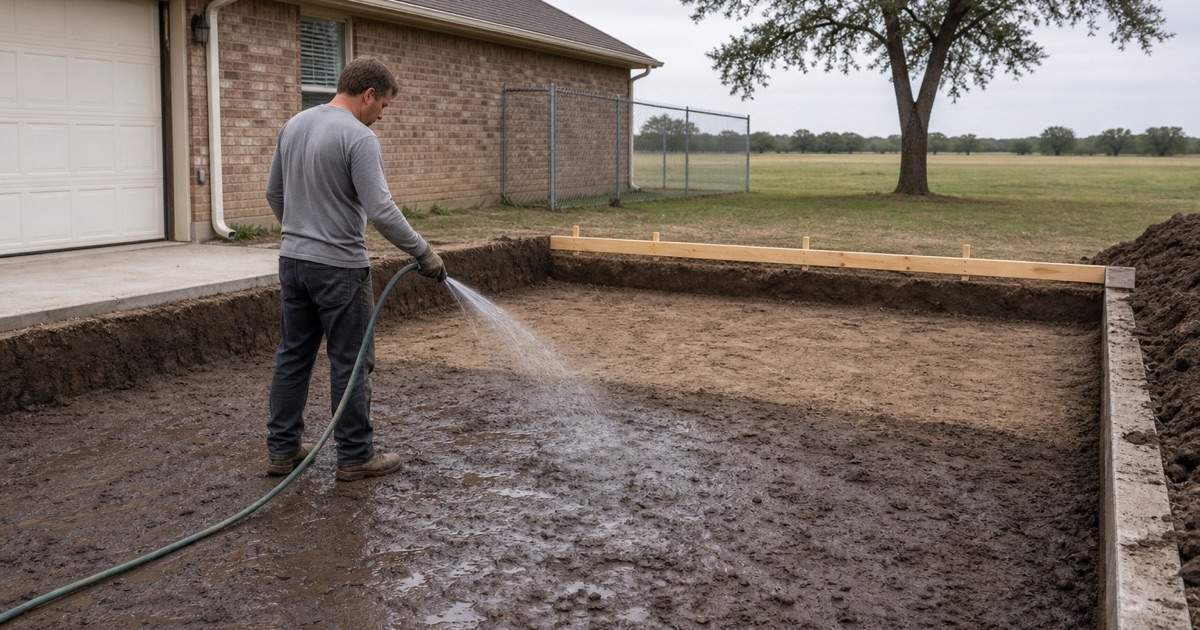
The practical consequence is that water moves quickly down through the surface and then stops. The sandy cap fills, the heavier layer beneath refuses to take the water, and the interface between the two becomes a place where water sits and then travels sideways.
That is why drainage design here has to consider what happens below the surface as well as across it. A patio pitched correctly can still be undermined by water perched on a layer eight inches down, and the useful fix is usually about where water is allowed to enter rather than only where it runs off. Directing roof water away from the edge of a slab does more good on this ground than almost any detail we could add to the concrete itself.
What It Does to a Base
A granular base laid over that interface can behave well the week it is placed and badly a year later, as water working along the boundary softens what sits beneath it. Compaction of the material immediately under the base therefore matters more than the thickness of the base itself.
We excavate past the cap and prepare what is actually going to carry the load. It costs a little more at the start and it is the difference between a slab that stays flat and one that develops a dip along one edge in its second or third season. It is also the part of a bid that is easiest to leave out invisibly, which is worth knowing when two numbers differ sharply.
The Half That Moves Without Qualification
The Vertisol half of the city needs no interpretation at all. Behring clay loam covers 20.0 percent across three map units, at a plasticity index of 31 in the plow layer rising to 39 to 42 below, with linear extensibility from 7.5 percent at the surface to 10 to 11 percent beneath it.
Heiden clay covers 13.6 percent at a plasticity index of 40 and linear extensibility of 12.0 to 12.2 percent throughout, with saturated hydraulic conductivity of 0.21 micrometers per second, and Houston Black covers a further 4.49 percent at a plasticity index of 44 with 12 percent linear extensibility. Ferris clay on 5 to 20 percent slopes covers 2.6 percent and is mapped at 100 percent Ferris, which puts a steep eroded slope of that material inside the city.
Why Carbonate Matters Here by Its Absence
Calcium carbonate is low across the clays here — Behring runs 1 to 6 percent and Crockett 0 to 1 percent in the horizons that matter. That is precisely the difference between this city and the calcareous ground elsewhere in the region.
Where carbonate is high it suppresses shrink and swell, so a high plasticity index overstates the movement that will actually occur. Here it does not, so linear extensibility tracks the plasticity index rather than contradicting it, and the ground genuinely does what the numbers say it will do. Carrying an assumption in from a job on calcareous ground is one of the more expensive errors available in this city.
Established Housing, and the Cracks That Come With It
What Fails on Older Flatwork Here
On flatwork that has been in service for decades over ground like this, the failure is usually a combination rather than one cause: joints spaced for a slab that was never going to sit still, water entering at an unsealed joint, and a base that has softened at the interface below it.
Diagnosing which of those is dominant is what decides whether a repair will hold. Replacing a slab while leaving the drainage and the base untouched buys a few years and repeats the original mistake at current prices, which is the outcome we most want to avoid selling anyone. We look under the slab rather than only at it, because the surface pattern alone rarely settles the question.
Seasonal Movement, and Where Cracks Appear
On the heavier half of the city, seasonal movement is enough to open joints, lift edges and produce cracks that follow no obvious line. Where jointing was adequate the relief happens where it was intended; where it was not, the slab chooses its own line and the result looks random even though it is not.
Two further conditions are worth knowing. Wilson clay loam covers 5.39 percent of the city and is the only somewhat poorly drained major unit in the set — ground where a slab sits over a seasonal water table rather than a dry profile. Whitesboro clay loam on 0 to 1 percent slopes, frequently flooded, covers another 3.45 percent, so frequent flooding is a mapped soil condition on a measurable share of this city rather than an occasional event.
Resurfacing Against Replacing a Settled Slab
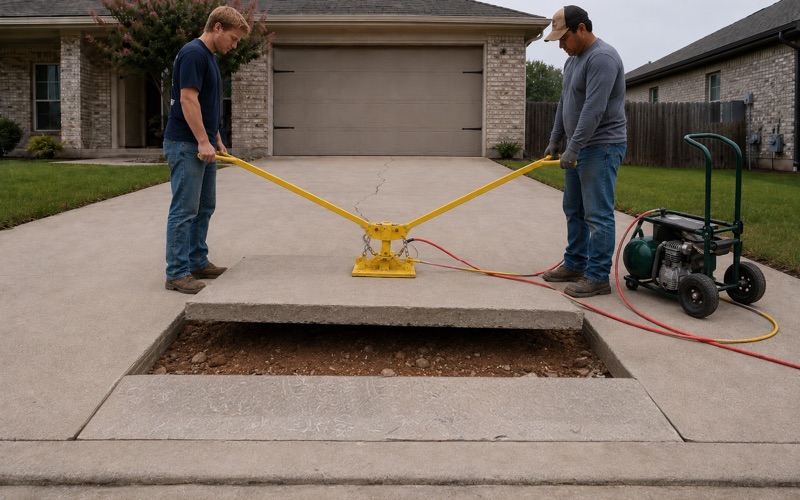
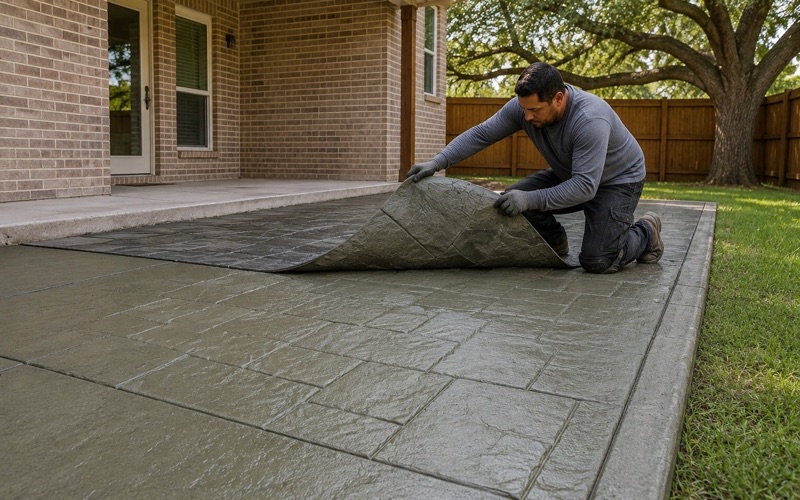
Where the concrete is structurally sound and has simply weathered, an overlay or a microtopping gives a genuinely new surface for a fraction of replacement, and it leaves the existing slab to carry on doing the structural work. Where a slab has settled rather than worn, lifting it back to grade is frequently the better answer than removal.
What decides between them is the cause rather than the appearance. A slab that dropped because water has been working the interface below it will drop again after a lift unless something about that changes, and we would rather explain that than take the easier sale and be called back.
Permits Here Follow the Model Code
One administrative note makes planning simpler in this city. Elgin adopted the 2021 residential code in March 2022 and did not amend the section listing work outside the permit requirement, so the model code’s own provision for sidewalks and driveways not more than 30 inches above adjacent grade, and not over any basement or story below, governs unamended.
That is a comparatively light regime, and it puts the burden of specification squarely back on the contract you sign. We write our scope to be specific about base preparation, thickness, reinforcement and jointing precisely because nothing in the process here is going to require any of it of us.
- 20+ Years Pouring Concrete
- Registered & Insured
- We Pour Our Own Jobs