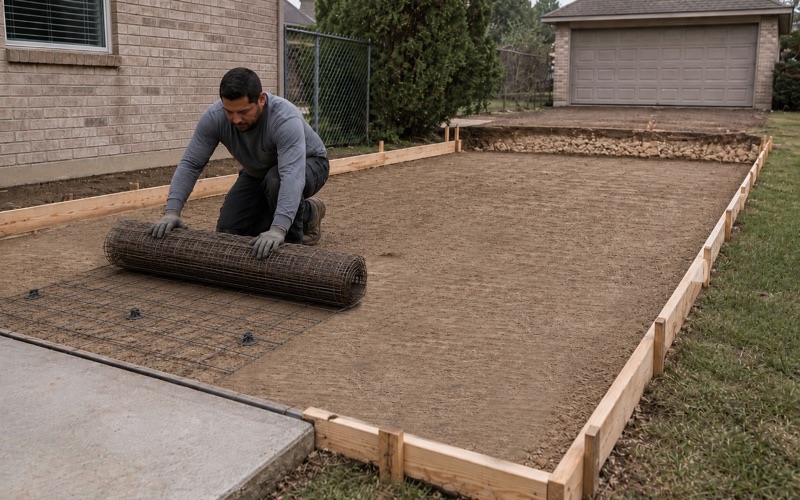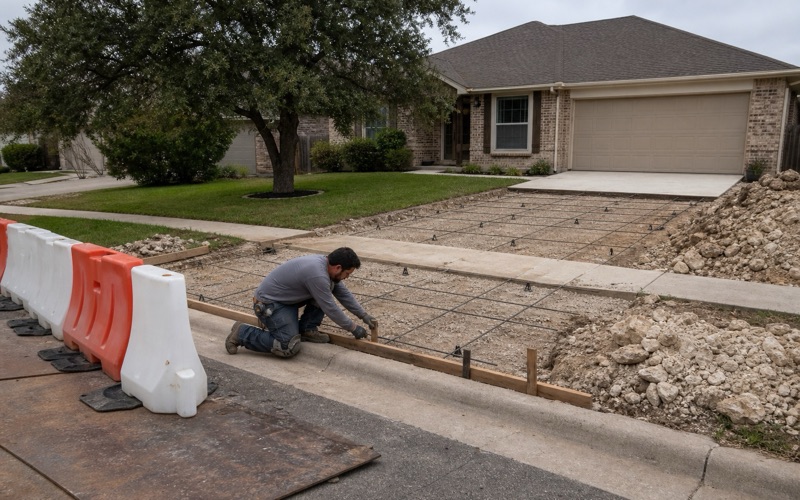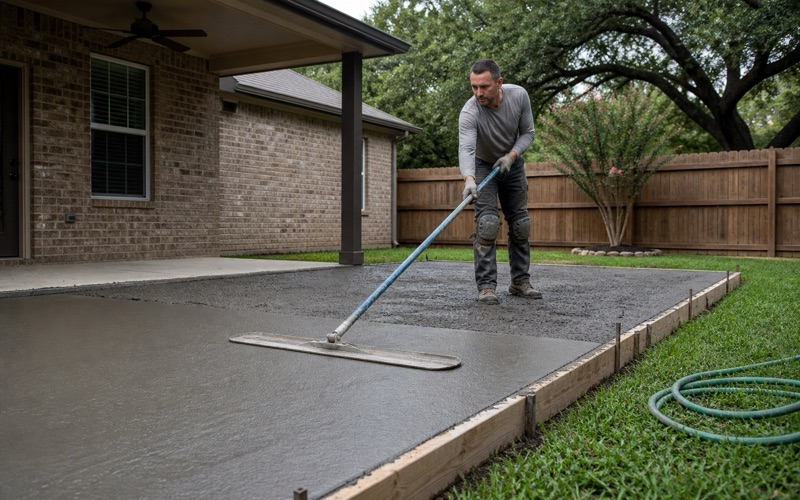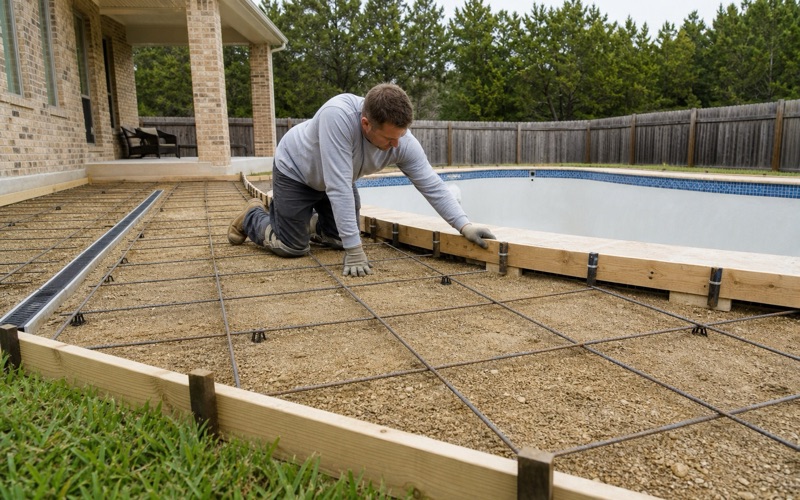
Cedar Park Elite Concrete works as a concrete contractor in Garfield, TX, and the work here is not what a contractor arriving from a suburb would expect to find. Most homes in this community were never poured a foundation in the ordinary sense: 495 of 754 housing units are manufactured homes, against 247 single-family detached houses.
More than 20 years in this trade has taught us that the pads, piers, steps and small slabs that go with manufactured housing are treated as trivial work by a great many contractors, and priced accordingly. They are not trivial. A pad carrying a home concentrates load at specific points, has to stay level over the same moving ground as any other slab, and is far harder to correct after the home is on it.
The second thing worth knowing is that there is no single description of the ground here. Thirty-two distinct soil map units cover twelve square miles, so what a trench opens in changes across the community and even within a single property.
Pads and Piers Where There Is No Slab Foundation
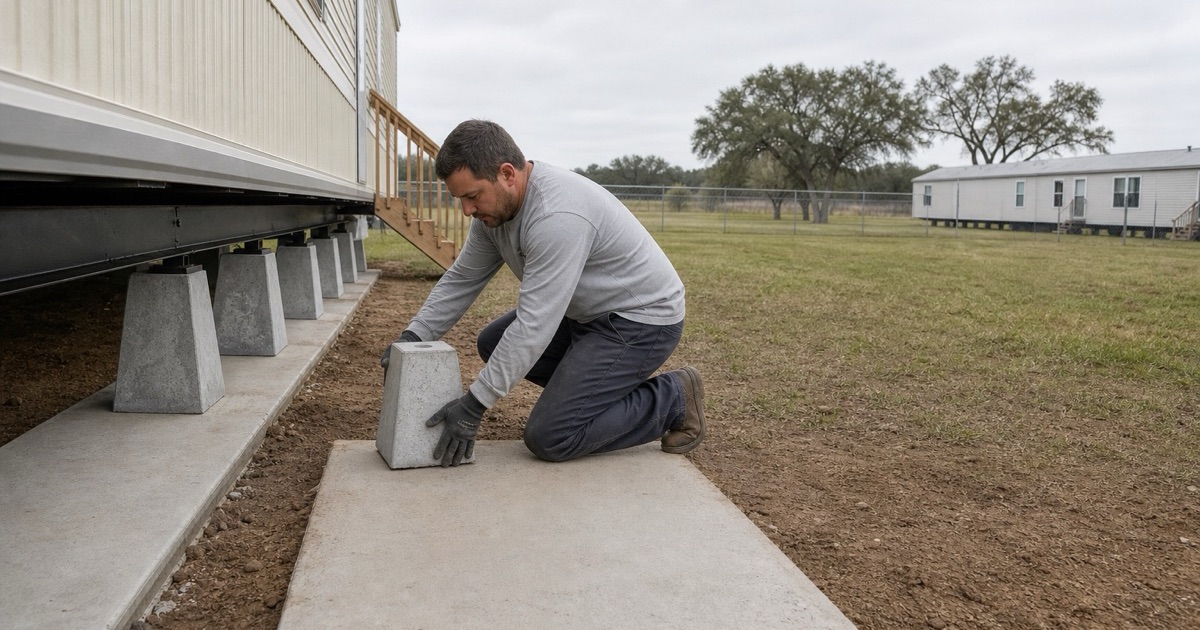
What a Manufactured Home Actually Sits On
A manufactured home transfers its weight through its frame to a set of support points rather than spreading it across a slab. Those points carry real load in a small area, which means the bearing under each one matters far more than it would under a continuous pour.
Where the support is inadequate or uneven, the home tells you before the concrete does: doors that stop latching, windows that bind, and gaps opening at interior seams. By the time those appear, correcting the cause means working under an occupied home, which is why getting the pad right at the start is worth so much more here than elsewhere.
Runners, Piers and Full Pads
There is more than one right answer, and which one suits depends on the home, the site and the budget. A full pad gives the most predictable support and the easiest future maintenance; runners under each frame rail cost less and work well on stable ground; individual piers are the cheapest and the most sensitive to what is underneath each one.
We will tell you which we are proposing and why rather than quoting a number against an unnamed method. On ground this variable, the cheapest option on paper is frequently the one that needs revisiting first.
Steps, Landings and Anchorage
The concrete around a manufactured home matters as much as the concrete under it. Steps and landings take daily traffic and are the most common thing we are called back to on somebody else’s work, usually because they were poured on uncompacted fill against the skirting and have settled away from the door.
Anchorage is the other item that has to be planned rather than retrofitted. Tie-down points, the routes for water and sewer, and the access needed to reach them later all belong in the design before the pour, because coring a finished pad to correct any of them is expensive and avoidable.
Looking for concrete-contractor closer to Dripping Springs? See Concrete-Contractor Services in Dripping Springs.
Ground That Changes Across Twelve Square Miles
No Single Soil, and Two Opposite Problems
A 192-point grid across this place returns 32 distinct map units, and no soil dominates. Bergstrom takes 17.7 percent of points, Houston Black 15.1 percent, Chaney 10.9 percent, Heiden and Wilson 8.3 percent each, Yahola 6.2 percent, and Tinn and Ships 5.2 percent each.
By soil order it runs Vertisols at 39.1 percent, Alfisols at 26.6 percent and Mollisols at 18.2 percent. Two thirds of the ground is therefore either high-movement clay or a sandy-surface soil over a clayey subsoil — and those two conditions want opposite details from a pad, which is the practical reason we sample rather than generalize.
The Clay End of the Range
Ships clay is the extreme here: 61 to 68 percent clay through the profile, a plasticity index of 34 to 40 and linear extensibility of 8.2 to 11.2 percent, with saturated hydraulic conductivity of 0.21 micrometers per second. Houston Black carries a plasticity index of 44 to 45 with linear extensibility of 12 percent and no restrictive layer to 203 centimeters.
Heiden runs a plasticity index of 40 to 45 with linear extensibility of 10 to 12.2 percent, and Ferris 45 to 59 with 7.5 to 17 percent. On any of those, a pad is riding ground that changes volume with the seasons, and the design has to account for movement rather than assume bearing.
The Sandy End, Which Fails Differently
The Alfisol quarter behaves nothing like that. Chaney fine sandy loam carries a plasticity index of 4 at the surface rising to 33 in the subsoil, with linear extensibility of only 1.5 to 4.5 percent. Wilson clay loam runs 16 to 39, and Crockett 11 to 38 with linear extensibility from 1.2 to 9.0 percent.
A sandy surface over a clayey layer beneath is a differential-support problem rather than a uniform-heave problem: the top foot compacts and drains like loam while the layer that actually moves sits underneath it. Reading a high plasticity index off the subsoil alone misdescribes what a crew will actually find in the trench, and it is the most common way a pad here gets specified wrongly.
Drainage That Varies Inside One Subdivision
Yahola very fine sandy loam sits in hydrologic group A with saturated hydraulic conductivity of 28 micrometers per second — roughly 130 times that of the Ships and Houston Black clays mapped on the same twelve square miles. Bergstrom, the single largest component, is group B at 9.0 micrometers per second with linear extensibility of 4.5 percent.
Hydrologic soil group splits four ways across the place: D at 43.8 percent of points, B at 27.1 percent, C at 21.4 percent and A at 7.8 percent. Runoff behavior is not uniform across a single subdivision here, let alone across the community, so a drainage design that works on one lot can be wrong two lots over.
Setbacks, Septic and Where Concrete May Go
The Drain Field Decides the Layout
On lots served by on-site sewage facilities, the septic system is the hard constraint on where anything can be poured. The drain field and its setbacks determine where a pad, a patio, a walk or a turnaround can sit, and none of those can be placed over a field or close enough to compromise it.
We verify that per lot rather than assuming it from the plat or from where the tank lid happens to be visible. Pouring over a field is one of the few mistakes in this trade that cannot be corrected without removing the concrete again.
Flood-Prone Ground Is Common Here
More than four points in ten across this place fall in a map unit whose own name carries a flooding phrase — rarely, occasionally or frequently flooded, or channeled. That is the soil survey’s own judgment about the ground, independent of any flood map.
It changes where a pad should sit and how high it should be, and it makes elevation a design decision rather than a default. We establish that before setting a finished level rather than matching whatever the neighboring pad happens to be.
Compaction on Fill Rather Than Excavation
Because nothing in the sample carries rock within reach — the deepest restrictions recorded are densic materials well over a meter down — excavation here is never priced by what a machine hits. It is priced by which of several unrelated soils the trench opens in, and by how that material behaves on the day.
Where fill is needed to reach a level, it goes in and gets compacted in lifts rather than dumped and graded. Fill placed loose under a pad settles, and settlement under a manufactured home is exactly the failure the whole design is trying to avoid.
Access, Approaches and Turnarounds on a Rural Lot
Getting a Truck to the Work
Rural lots here usually have room to work, which is a genuine advantage on price. Where they do not — a long soft drive, a narrow gate, an approach that will not carry a loaded truck — the access becomes part of the job rather than a detail, and it is better priced honestly than discovered on the morning of a pour.
We look at how concrete will physically reach the work before quoting, and where a pump is the sensible answer we say so at the start rather than adding it later.
Approaches and Turnarounds That Take Real Vehicles
An approach on a rural lot carries delivery trucks, trailers and sometimes the home itself, which is a different loading case from a suburban driveway. Width, radius and the strength of the section all follow from what will actually use it rather than from a standard detail.
Turnarounds are worth building deliberately for the same reason. A vehicle that has to reverse a long drive will eventually go off the edge of it, and an edge repeatedly driven over on soft ground fails from the side in rather than from the surface down.
- 20+ Years Pouring Concrete
- Registered & Insured
- We Pour Our Own Jobs