Cedar Park Elite Concrete works as a concrete contractor in Hornsby Bend, TX, and this place produces one of the most common and most expensive misunderstandings in our trade. There is no city here to issue a building permit, and owners reasonably conclude from that fact that nobody is watching what gets built.
More than 20 years of pouring in this county has taught us how wrong that conclusion is. The county requires an inspection before concrete is placed on a foundation, the obligation to arrange it falls on the builder rather than on a public office, and failing to make that call is a criminal matter rather than a paperwork slip.
The practical difference is that nobody will chase you. There is no plans examiner working through a queue and no automatic reminder, so the whole system depends on the contractor knowing the requirement exists and acting on it without being prompted by anyone. That places an unusual amount of weight on which contractor you hire, because the crew is effectively the only quality control on the job.
Who Inspects When There Is No City to Permit It
The County Requirement, and Who Has to Act
Travis County Code section 480.005(1) requires a minimum of three inspections, including the foundation stage, before the placement of concrete. Section 480.006 puts the obligation of engaging the inspector squarely on the builder rather than on the county.
That second provision is the one that catches people out. The inspection is not scheduled by an office holding your project on a list — somebody on the job has to engage an inspector, and where nobody does, the concrete simply goes in unlawfully and stays there. It also means an owner cannot assume the requirement was handled simply because work proceeded without anyone objecting.
What Happens If Nobody Calls It
Section 480.009 makes failure to notify a Class C misdemeanor. That is a criminal classification rather than an administrative penalty, which is an unusually sharp instrument for something that looks from the outside like a scheduling failure.
It is also not a risk an owner can knowingly accept on a contractor’s advice. The obligation attaches to the building work itself, so a homeowner who agrees to skip it is the one left with an uninspected foundation on their own property and no record that it was ever looked at.
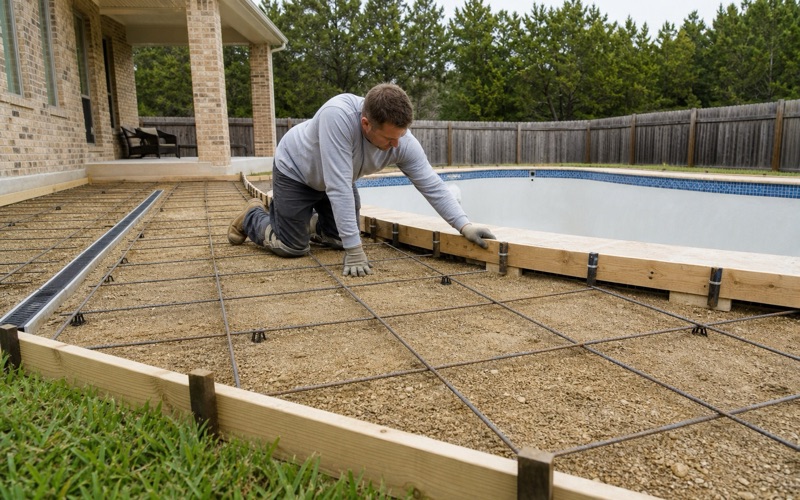
We treat the inspection as a fixed point in the schedule for exactly that reason. Forms and steel are complete and open to view before we ask for it, and the pour waits until it has happened, which costs a day at most and removes the exposure entirely. Scheduling it early also gives us room to correct anything the inspector flags before the concrete is on site rather than after.
Development Permits on Unincorporated Land
Section 464.061 requires a development permit before any construction begins. That requirement sits above the inspection regime rather than replacing it, so a project can need both, and the order in which they happen matters to the schedule. Establishing whether a given job triggers it is a question for the county rather than a judgment call to make on site.
We establish which of the two apply to a given job before quoting rather than after mobilizing a crew. On unincorporated land the answer varies more than owners expect, and the cost of getting it wrong attaches to the property rather than to the contractor who has already left.
Looking for concrete-contractor closer to Taylor? See Taylor Concrete-Contractor.
Which Rules Apply Inside an Extraterritorial Jurisdiction
Being Outside a City Is Not the End of the Question
Land outside a municipality can still sit inside that municipality’s extraterritorial jurisdiction, and the authority a city holds there is real but partial. Subdivision and platting powers generally reach into it while building permits generally do not, which produces a genuinely confusing picture for a homeowner trying to work out who to call.
The practical consequence is that the answer is not a single office. We work out which authority holds which piece of a project before it starts, because the alternative is discovering the split halfway through and losing weeks to it. We would rather spend an afternoon confirming that than have an owner discover it from a stop-work conversation.
Utilities That Belong Somewhere Else
The other thing worth settling before anyone digs is who owns what is already in the ground. Service lines, meter boxes and cleanouts turned up on a job here can belong to a utility whose jurisdiction has nothing to do with the office that permits your work.
Damaging one of those is expensive and entirely avoidable with a locate. It is not a formality on ground where the utility owner and the permitting authority are different organizations with different procedures and different repair rates. The repair rate is set by the utility rather than negotiated, which is another reason the locate is not optional.
Documenting What Nobody Else Will
Where inspection is limited and specification is not enforced by a plans examiner, the contract becomes the specification. That is the honest consequence of building somewhere with a light regulatory touch, and it cuts in both directions for an owner.
We write our scope to be specific about thickness, reinforcement, base preparation and jointing precisely because no public official is going to require any of it here. An owner should expect that level of detail from any bid on this ground, and treat one that reads as a single line and a price with real caution.
The Ground: River Terrace Rather Than Prairie
Three Soil Orders, None of Them Dominant
This is river-terrace alluvium rather than the prairie clay that surrounds it. A 194-point sample returns Bergstrom as the leading component at 31.4 percent of points, ahead of Yahola at 11.9 percent, Heaton at 8.8 percent, Travis at 7.2 percent, and Weswood, Tinn and Houston Black at 6.2 percent each.
By soil order it runs Mollisols at 31.4 percent, Vertisols at 24.7 percent, Alfisols at 20.6 percent and Entisols at 13.9 percent. Three orders each hold a fifth or more of the ground, which means no single description of this place is true across all of it, and a base specification that suits one part of it is wrong for another. Averaging across those orders produces a number that describes no actual lot in this place.
Free-Draining Sand and What It Does to a Base
Yahola very fine sandy loam sits in hydrologic group A with a plasticity index of 4 to 5 and saturated hydraulic conductivity of 28 micrometers per second, roughly three times the Bergstrom figure. That is free-draining material, and a base course laid on it behaves nothing like a base course laid on clay.
Bergstrom itself is well-drained group B material with a plasticity index of 17 to 19 at 19.5 to 31.5 percent clay, described to 203 centimeters with no restrictive layer recorded. On that ground the compaction achieved and the moisture at the time of placement do far more for a finished slab than any other decision available to us. Placing on it in the wrong moisture condition wastes the advantage the material gives you, which is why we watch the weather rather than the calendar.
Differential Support Rather Than Movement
Linear extensibility across the dominant components is low: 4.5 percent for both Bergstrom units, 1.5 percent for Yahola and 1.5 percent for Heaton. Shrink-swell is not the governing risk across the majority of this ground, which changes what a slab needs to be designed against.
Heaton is the interesting case, because it is a loamy fine sand with a plasticity index ranging from 2 to 15 through the profile and clay as low as 7.5 percent at the surface, sitting over a considerably heavier subsoil. Low-plasticity sand over a clayey horizon is a differential-support problem rather than a heave problem, and the two conditions want quite different answers from a slab.
Where a slab spans a change between those two conditions, the joint layout has to anticipate it rather than ignore it. We would rather put a joint where the support changes than let the slab find that line on its own, which it will do within a season or two.
The Quarter That Does Move
About a quarter of this place is Vertisol and it deserves to be priced differently. Tinn clay carries a plasticity index of 41 with linear extensibility of 9.3 to 10 percent, Houston Black 44 to 45 with 12 percent, Ferris 45 to 59 with 7.5 to 17 percent, and Burleson 41 to 44 with 7.2 to 8.0 percent.
Hydrologic soil group splits the place four ways as well — group B at 46.9 percent of points, D at 28.9 percent, A at 13.9 percent and C at 10.3 percent. Sixty-one percent of this ground drains and twenty-nine percent does not, so which side of that split your lot falls on changes the drainage design, the base and ultimately the price. We check it rather than assume it from an address.
- 20+ Years Pouring Concrete
- Registered & Insured
- We Pour Our Own Jobs