Cedar Park Elite Concrete works as a concrete contractor in Hudson Bend, TX, and after more than 20 years of pouring in this county we have learned to quote excavation here differently than anywhere else we work. On this peninsula, what a machine hits underneath you is not a neighborhood characteristic. It is a lot characteristic.
Two houses on the same street can sit on ground that behaves completely differently once the bucket goes in. One rips in an afternoon. The other stops on solid ledge shallow enough that the excavation, not the concrete, becomes the largest number in the quote.
That is why we will not price digging here from an address and a photograph. We come out and look, and the quote we hand you reflects what is actually under your lot rather than an average of the peninsula.
Rippable Rock and Rock That Is Not, on Neighboring Lots
The Two Regimes Under This Peninsula
Sampling the land inside this place at 241 interior points splits it almost evenly between two soil regimes with opposite implications for a machine. About 49.4 percent of those points fall in Brackett-dominated units, where the restriction is paralithic bedrock the soil survey itself calls weakly coherent, at a representative 46 centimeters — roughly 18 inches — on the gentler unit and 36 centimeters, about 14 inches, on the steeper one.
The other 46.9 percent falls in Eckrant-dominated units, where the restriction is indurated lithic bedrock at a representative 20 centimeters, about 8 inches. The first is rock a machine can rip. The second is rock it cannot. Two adjoining lots here can carry refusal depths a foot apart and hardness classes that are not the same category of material at all.
Reading a Plasticity Index Without Its Partner
The lab numbers on these two soils have to be read in pairs or they will mislead you, and this is where a contractor working from a general reputation for expansive clay gets it wrong. Eckrant carries a representative plasticity index of 34, a liquid limit of 63 and 50 percent clay, which read alone predicts a heaving, difficult soil.
Its linear extensibility is only 2.8 to 5.1 percent, because the profile carries 6 to 25 percent calcium carbonate. Brackett, by comparison, runs a plasticity index of 17 to 18, a liquid limit of 39 to 42, 30 percent clay and linear extensibility of 2.3 to 3.3 percent with 60 to 65 percent calcium carbonate. The heave a plasticity index of 34 seems to promise is not what the extensibility figures describe, and designing for the wrong one costs money in both directions.
Where Level Ground Is Still Shallow
The instinct on a hilly peninsula is to read slope as a proxy for depth, and here that fails. The 6.6 percent of land mapped as Eckrant and Speck soils sits on slopes of 0 to 2 percent — flat ground — with indurated rock at 20 centimeters under 63 percent of it and at 46 centimeters under the 32 percent that is Speck.
Level does not mean deep. A flat building pad on this peninsula is exactly as likely to stop a machine as a sloping one, and it is the flat lots where owners are most surprised by an excavation number.
Looking for concrete-contractor closer to Round Rock? See Concrete-Contractor in Round Rock.
Why an Excavation Quote Here Needs Your Lot, Not Your Street
What We Actually Do Before Pricing
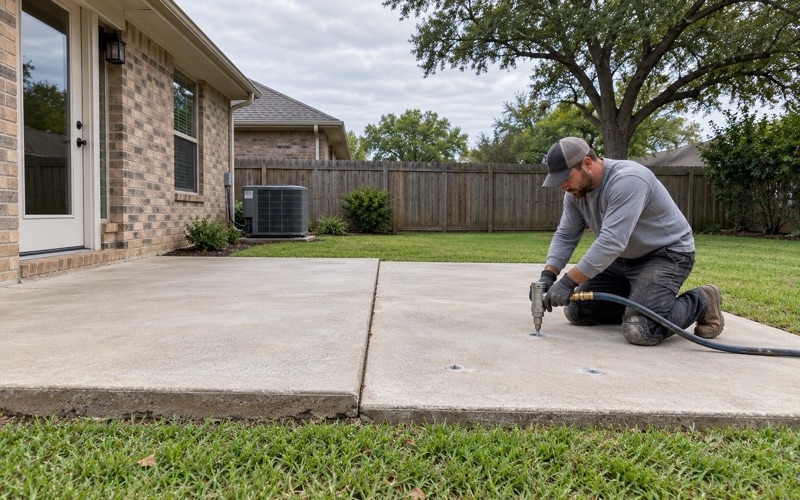
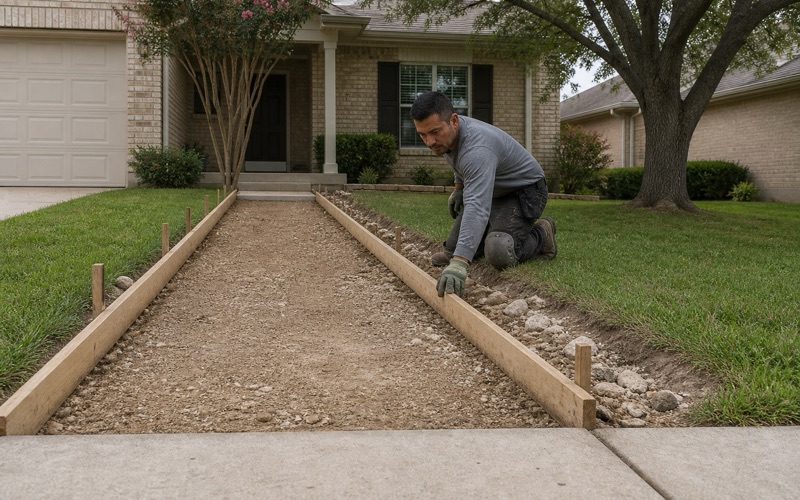
We probe. Before a number goes on paper for anything involving depth — a slab, a pad, a retaining wall footing, a driveway rebuild — we find out where refusal is on your ground and what kind of material it is when we get there.
It costs us an hour and it is the difference between a quote that holds and a quote that gets revised on day two. A price given here without anyone opening the ground is a price with a change order already built into it.
The One Deep Soil on the Peninsula
There is one exception worth knowing about. A sliver of roughly 3.3 percent of the land is Volente silty clay loam, which records no bedrock restriction on its major component through 150 centimeters and is the only unit here in hydrologic soil group C rather than D.
If your lot sits on it, the excavation conversation is an ordinary one and the drainage conversation gets easier too. It is a small share of the peninsula, and we would rather confirm you are on it than assume you are not.
Septic Fields and Where a Slab Can Go
On-site sewage facilities are permitted through Travis County for unincorporated land, and there is no centralized wastewater provider covering this place as a whole. That makes the septic field a hard constraint on layout: where the drain field and its setbacks sit determines where a patio, a drive or a pad can legally and sensibly go.
We verify that per lot rather than assuming it from the plat. Pouring over a field, or close enough to compromise it, is an expensive thing to discover afterward.
Working a Lakefront Approach
Whether the County Maintains Your Road
The first question on a driveway here is not what it will cost. It is who maintains the road it connects to. Travis County permits a driveway connecting to a maintained county road; a connection to a state road is a TxDOT permit; and the county states plainly that it does not issue permits for driveways connecting to unmaintained or unaccepted roads.
On a peninsula platted in the middle of the last century, road status is genuinely uncertain on some streets, and it is the first thing we check rather than the last. There is also no city building department here — this is unincorporated Travis County, and residential work runs through the county’s Transportation and Natural Resources permits.
Approach Types Where There Is No Curb
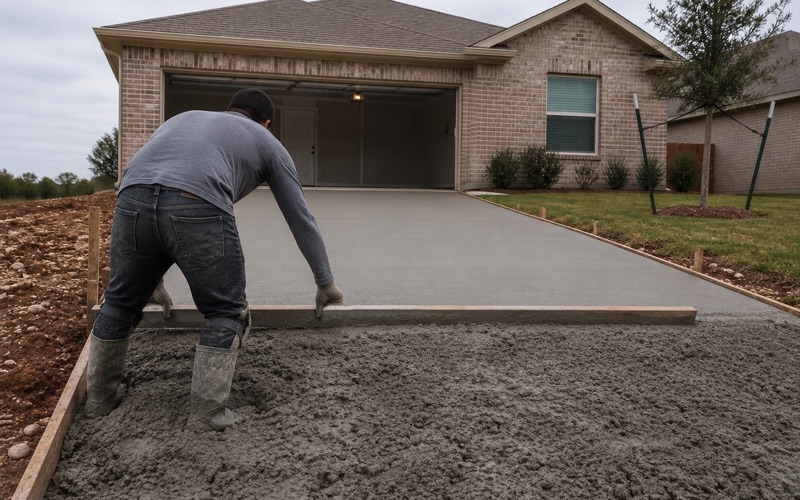
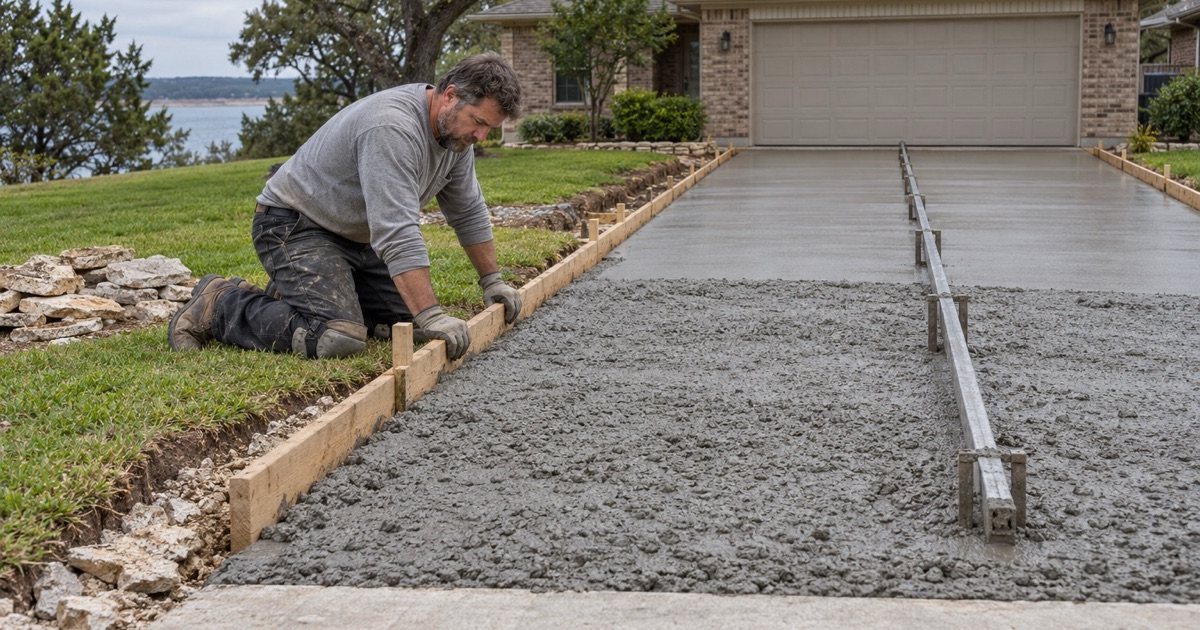
Most streets on a lake peninsula are uncurbed, and the county recognizes three approach conditions: straight tie-in where there is no roadside ditch, dip style where the ditch is less than 12 inches deep, and culvert style where it is deeper than that. Which one you get is decided by the ditch at your frontage, not by preference.
Where a culvert is required, corrugated metal pipe is the only material permitted in the right-of-way, at a minimum 18 inches diameter or a 15 by 21 inch oval Design 2 pipe, and culvert style driveways must include concrete safety end treatments. If a compliant culvert cannot physically be placed, the county’s answer is a dip-style driveway instead.
Grades, Spacing and the Rules on Your Frontage
The approach itself must be paved with concrete, the grade must not exceed 15 percent unless the county approves otherwise, the angle of approach is approximately 90 degrees, and where a sidewalk crosses the driveway the slope is capped at 2 percent. Ditch line grading has to maintain positive drainage along the full length of the property.
Spacing is capped as well: two approaches per street per property, at least 35 feet inside edge to inside edge on curb-and-gutter streets or 100 feet center to center on other types, and no closer to an intersecting right-of-way than 60 percent of the parcel frontage or 50 feet, whichever is closer. On narrow lakefront frontages those numbers decide the design before anyone draws it.
What Refusal Depth Does to a Slab Price
Slabs, Pads and Shallow Ledge
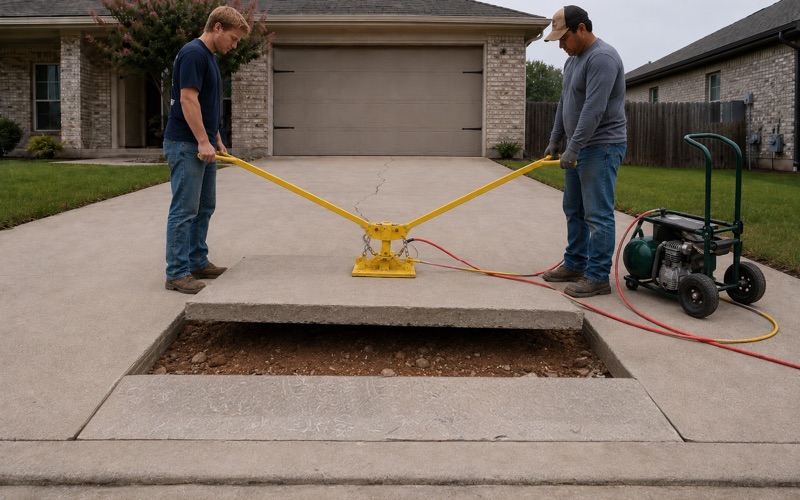
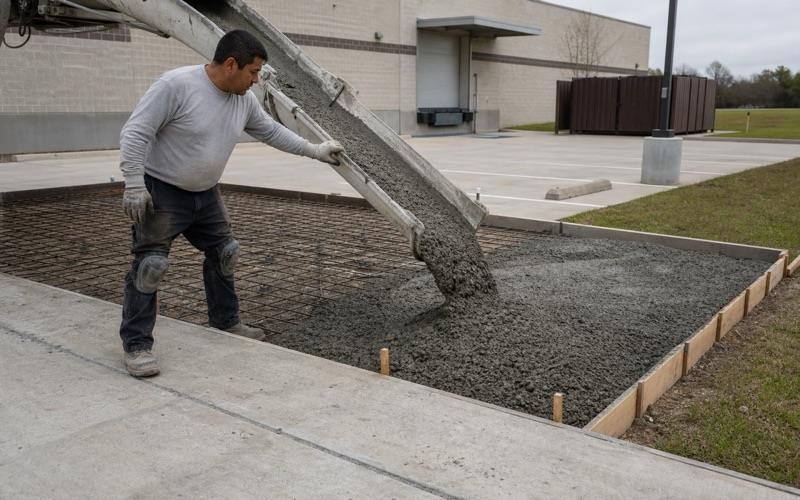
Where rock is at 8 inches, a slab that wants a deeper section is a different job from the same slab on Brackett. Sometimes the right answer is to work with the ledge and bear on it, which is a genuinely good foundation; sometimes it means breaking material out. What it never means is quoting the two the same way.
Small pads carry this most sharply, because the excavation is a large fraction of a small job. A hot tub pad, an equipment pad or a mobile home tie-down slab can double in price across a property line here, and that is a real difference rather than a markup.
Retaining Walls on the Steep Units
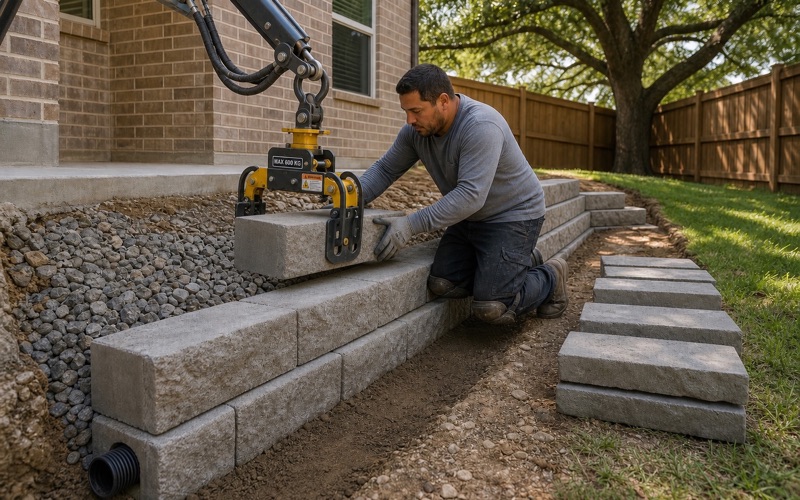
About 5.4 percent of the land is mapped as Eckrant-Rock outcrop complex on 18 to 50 percent slopes — 55 percent Eckrant and 35 percent bare rock outcrop, at representative slopes of 45 to 50 percent. That is ground where a retaining wall rather than a slab is the actual project.
Travis County treats a residential retaining wall as its own permit, with a site plan showing wall type and location, top and bottom elevations, an erosion and sedimentation control plan, and all easements and setbacks. A wall over 5 feet tall needs a site plan sealed by a Texas licensed engineer, and the permit has to be posted where it is visible from the public right-of-way before work starts.
Replacement Flatwork on an Older Housing Stock
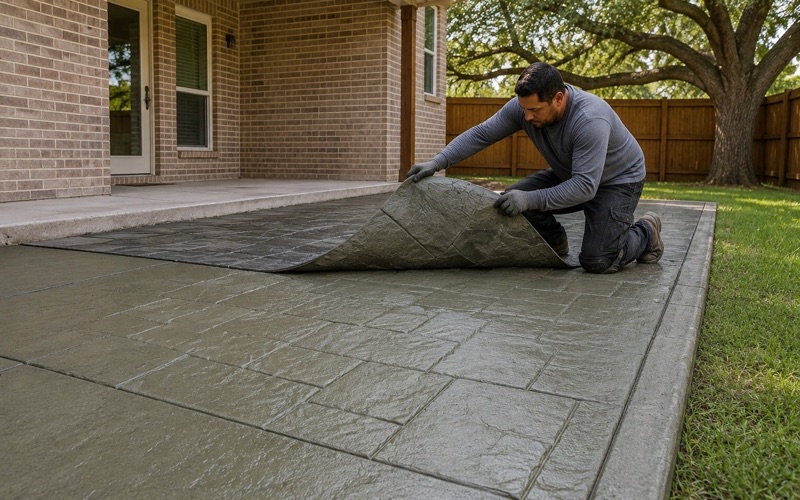
The reputation of a lakeside address suggests newer construction, and the housing here is more mixed than that. The median year built is 1997, about a fifth of units date from the 1980s, and 12.3 percent were built before 1980. Replacing thirty- and forty-year-old drives, walks and patios is ordinary work on this peninsula rather than an occasional call.
There is a second segment that gets overlooked as well: 6.2 percent of housing units here are mobile homes and another 2.0 percent are classed as boat, RV or van. Pads, tie-downs, hookups and small slabs are a real share of the work, and they are not a suburban driveway priced smaller.
- 20+ Years Pouring Concrete
- Registered & Insured
- We Pour Our Own Jobs