Cedar Park Elite Concrete works as a concrete contractor in Jarrell, TX, and this is a city where the standard soil test tells you less than you would expect. Every soil unit mapped here clears the plasticity index threshold that the residential code uses to classify a soil as expansive, which sounds like a straightforward answer until you look at the second number.
More than 20 years of pouring in this county has taught us that plasticity index and linear extensibility have to be read as a pair. One of them describes how a soil behaves in a laboratory test; the other describes how much it actually changes volume when it gets wet and dries out again. In this city those two numbers point in noticeably different directions on most of the ground.
The practical result is that specifying flatwork here from the plasticity index alone overbuilds on much of the city and underbuilds on the rest. Which of those applies to your address is a matter of record rather than of judgment, and it is the first thing we look up. Getting it right in either direction saves money, which is not a claim we can make about many site checks.
Why a High Plasticity Index Here Does Not Mean High Movement
The City Core, and the Numbers That Disagree
The city core along Town Center Boulevard is mapped as Austin silty clay, a carbonatic Mollisol carrying a plasticity index of 37 and a liquid limit of 56. Read alone, that is a soil most contractors would design defensively against.
Its linear extensibility is 5.1 percent. That is a fraction of what the plasticity figure implies, and it is the number that describes what the ground will actually do to a slab through a wet-to-dry cycle. Designing that ground as though it were prairie clay spends money on a risk the measurements do not support. It is also the reason a contractor arriving with one standard detail for the whole county will be wrong here more often than not.
What Carbonate Content Does
The reason for the gap is calcium carbonate. Austin silty clay here runs to around 40 percent carbonate, and Castephen, which covers the middle and south of the city footprint, carries up to 60 percent with a plasticity index of 27 to 32.
Carbonate-rich profiles hold their volume far better than their clay percentage suggests, because the carbonate occupies space that would otherwise be available to swell. That is why the shallow calcareous soils across this part of the county behave so differently from the deep prairie clays a few miles east, despite testing similarly on a plasticity index. The effect is well documented and it is measurable rather than a matter of local opinion, which is why we quote the figure rather than the reputation.
Where the Ground Genuinely Does Move
There is an exception and it matters. Houston Black clay — plasticity index 44, liquid limit 70, 54 percent clay and linear extensibility of 12 percent — is mapped on the south side of the Sonterra area rather than under the older city center.
So a single citywide assumption is wrong in both directions. West of the interstate the ground is Denton silty clay at a plasticity index of 30 to 37, different again. The spread in linear extensibility between roughly 5 percent and 12 percent across this one city is what separates one address from the next, and it changes reinforcement, jointing and base preparation. We look up the mapped unit for the specific parcel before pricing, and it takes minutes rather than a site visit.
Looking for concrete-contractor closer to Shady Hollow? See Concrete-Contractor Services in Shady Hollow.
Flatwork on a House Built in the Last Few Years
New Construction, Settled Backfill and What Fails First
A large share of the housing here is genuinely recent, with 425 of 1,222 units built in 2020 or later and 84.6 percent of the stock single-family detached. On houses that new, the flatwork problems we are called to are almost never material failures.
They are construction-sequence failures. Backfill against a foundation that was placed loose and has been consolidating ever since, a downspout discharging at a slab edge, or a drive poured over a service trench that was never compacted will all produce settlement inside a few years, and none of them are fixed by better concrete. On a house only a few years old, that is genuinely good news, because every one of those causes is cheaper to correct than a slab is to replace.
Diagnosing Before Replacing
On work this young, replacing a slab without finding the cause is the most expensive available option, because the replacement inherits the same conditions. We would rather spend an hour establishing whether the problem is a trench, a drainage path or the ground itself.
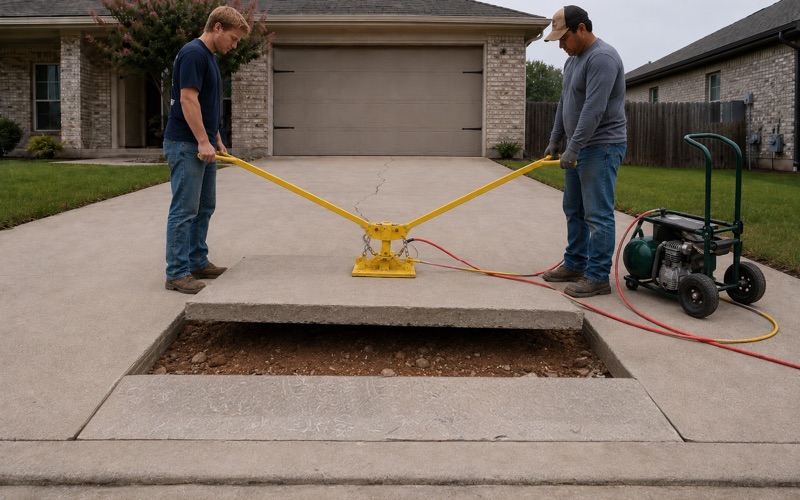
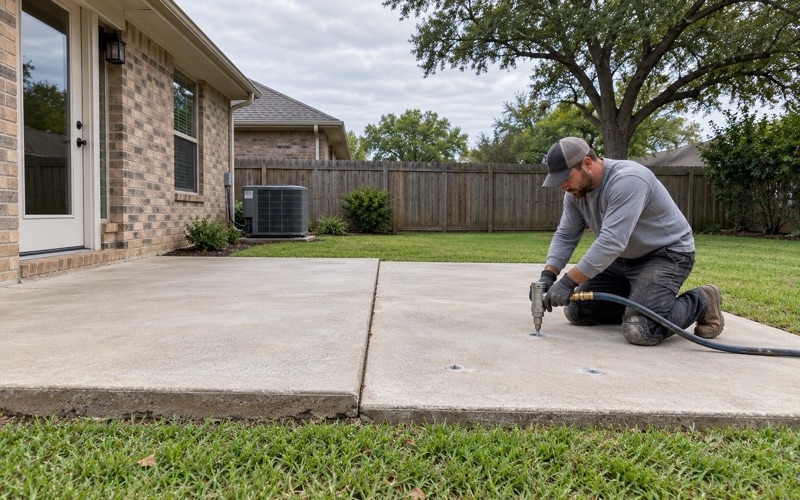
Where the cause is a void under an otherwise sound slab, lifting it back to grade costs a fraction of tearing it out. Where the cause is water arriving somewhere it should not, we will say so plainly even though redirecting a downspout is not concrete work and not something we invoice for. A lift also leaves the existing slab in place, which on a young driveway is usually the better material anyway.
The Reviewing Authority Is Often Not the City
A practical complication worth knowing early: a great deal of housing sold as Jarrell sits outside the city limits inside municipal utility districts. Sonterra was created effective September 2005 over initial boundaries of 1,135.71 acres, and Cool Water is a planned community of roughly 750 homes just outside the city limits.
For those addresses the reviewing authority is frequently Williamson County plus a district rather than the city, which changes who permits the work and what standards apply. We establish that before quoting, because applying to the wrong authority costs weeks and applying to none at all costs more. District boundaries do not follow the street names people use for the area, so the answer has to come from a map rather than from an address.
Building to the City’s Written Standards
Registration and Insurance
All contractors doing business inside the city must register with the city and carry a certificate of insurance showing at least $300,000 in general liability coverage. Texas issues no state license for a concrete contractor, so registration and insurance are two of the very few credentials on this kind of work that can actually be verified.
We keep both current as a standing matter rather than assembling them per job. An owner comparing bids here can reasonably ask to see both, and a contractor who cannot produce them is telling you something. Insurance in particular is worth confirming rather than assuming, since the certificate is dated and coverage lapses quietly.
Sidewalks, Curbs and a Continuous Pour
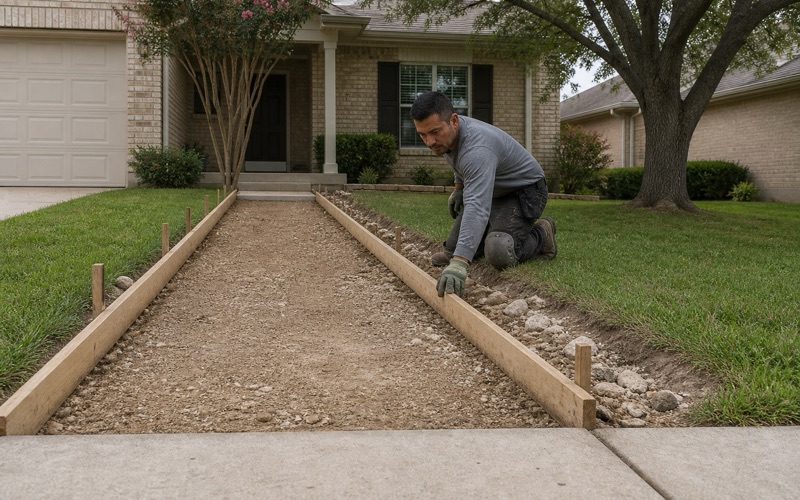
The development code sets sidewalks in residential developments at a minimum width of 72 inches and states that there shall be no gap between the curb and the sidewalk. That second requirement changes the work rather than merely the dimensions.
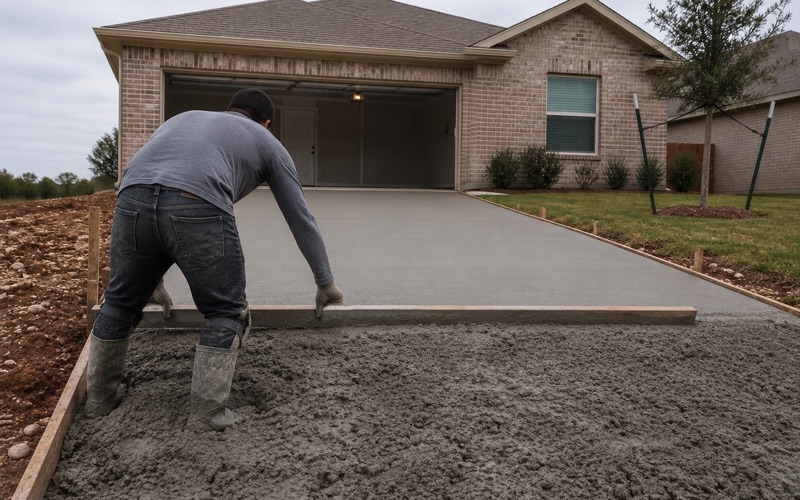
With no gap, the curb and the walk become one continuous line of forming and placement rather than two separate operations with a strip of grass between them. Shared pedestrian and bicycle walkways are set at 8 to 12 feet wide, which is a different pour again in terms of jointing and finishing. That has real scheduling consequences, because the two elements have to be formed, poured and finished together rather than in separate visits.
Parking, Loading and Engineered Surfaces
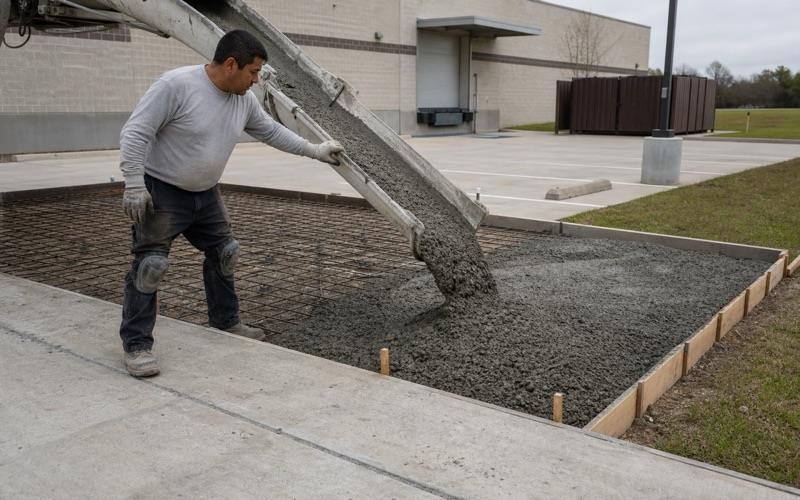
All open off-street parking and vehicular use areas must bear an all-weather, geotechnically engineered surface designed to meet a loading requirement of 75,000 pounds, with parking lot geometry designed to the City of Round Rock’s transportation criteria manual as amended.
That loading figure puts commercial paving here firmly in engineered territory. It is not a slab thickness a contractor picks from habit, and a bid that does not reference a pavement design has not addressed the requirement at all. We price commercial work here against a pavement design or we tell you we need one before we can price it honestly.
Why the Online Code Is Not the Whole Specification
One caution for anyone pricing from the published code: the slab, curb and pavement specifications are not in the code text. Section 6.09 delegates the design of improvements to the separate City of Jarrell Design and Construction Standards.
A bid drawn only from the online code is therefore incomplete by construction, and it is a common way for a number to come in low. There is a flood provision worth knowing too — in a special flood hazard area, new construction and substantial improvements must have the lowest floor at least 12 inches above base flood elevation, a full foot of freeboard above the federal minimum, measured against maps dated September 2008. We work from the design and construction standards themselves, which is the only way to know what the finished detail actually has to be.
Pads for Manufactured Homes and Outbuildings
Manufactured housing is 11.7 percent of the stock here, which makes pads, tie-down slabs, steps and small outbuilding foundations a real share of the work rather than an occasional request. They are frequently treated as trivial pours and they are not.
A pad carrying a manufactured home concentrates load at specific points, and the ground under it still needs compaction, drainage and reinforcement suited to whichever soil unit the lot sits on. We build them to the same standard as any other structural slab, at a size that suits the actual home rather than a generic rectangle. Tie-down anchorage and the routes for water and sewer also have to be planned into the pour rather than cut into it afterward.
- 20+ Years Pouring Concrete
- Registered & Insured
- We Pour Our Own Jobs