Cedar Park Elite Concrete has worked as a concrete contractor in Round Rock for more than twenty years, and the first thing we settle on any job here is which side of town the address sits on. That is not small talk. It decides how deep the excavator gets before it stops, what the subgrade has to be conditioned to, and how much of the budget disappears into the ground before a yard of concrete ever arrives.
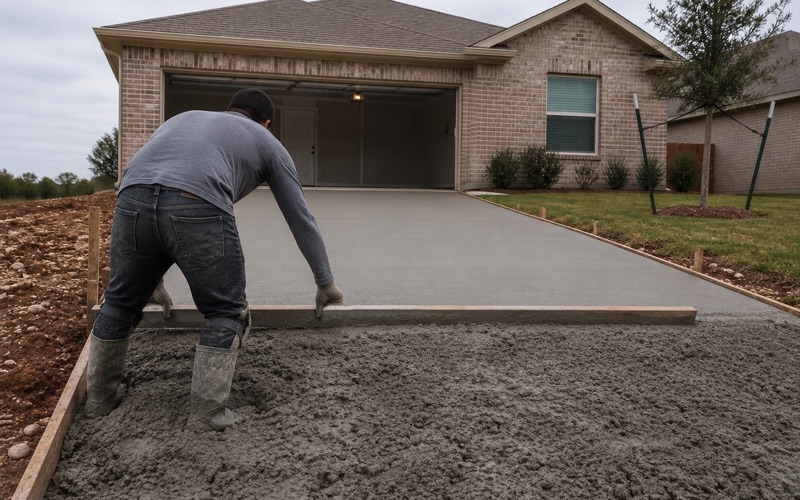
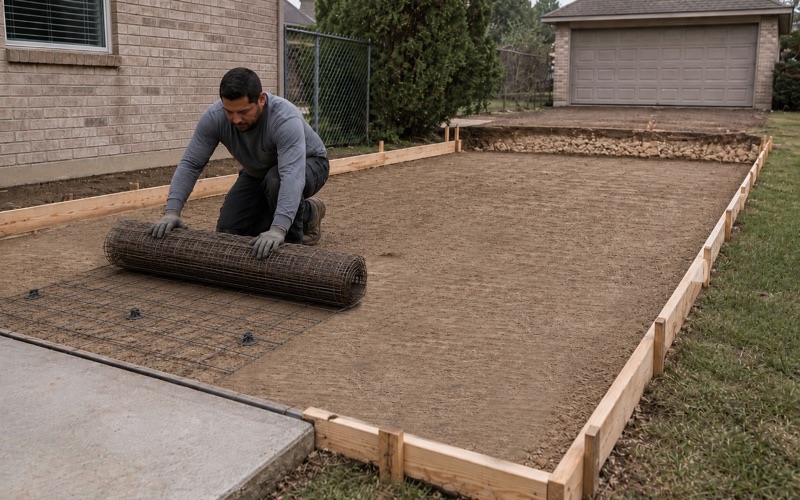
We pour driveways, house and garage slabs, equipment and storage pads, and commercial flatwork, and we do our own site prep and excavation rather than subletting the part of the job that most often decides whether the finished surface holds. Two decades on, our own crews still pour our own work.
Texas issues no state license for a concrete contractor, so the credentials a customer can actually verify are city registration, insurance on file and the surety a right-of-way ordinance requires — and ours are current. Where the work reaches the public street, we say so in the quote rather than after the forms are set.
Why two addresses in one city need two different slabs
Soil survey data refuses to describe this city as one place. Five SSURGO point queries inside the city limits returned five different map units: Eckrant stony clay on 0 to 3 percent slopes downtown, Eckrant cobbly clay on 1 to 8 percent slopes in the northwest, Austin silty clay in the northeast, Houston Black clay in the southwest, and Castephen silty clay in the southeast.
Depth to refusal is the line item that moves
Eckrant carries indurated limestone bedrock at a representative 28 centimeters, roughly eleven inches down. Castephen carries weakly coherent paralithic bedrock at about 41 centimeters and Austin at 74 centimeters, while under the Houston Black map unit no bedrock restriction is published at all within the 203-centimeter profile; the nearest are Heiden densic material at 122 centimeters and Fairlie paralithic bedrock at 137 centimeters.
That is a sevenfold swing in how far a machine travels before it meets rock, inside one set of city limits. Limestone rock excavation is a hammer-and-hours line item; digging deep clay to grade is not. Quoting both the same way means one customer subsidizes the other, so we find out what the slab will sit on before we price it.
Two problems that ask for opposite answers
On the southwest side the material is a deep prairie Vertisol. Houston Black, 80 percent of that map unit, runs a representative plasticity index of 44 to 45, clay at 54 to 55 percent, liquid limit 70 to 71, linear extensibility of 12 percent through the profile, and saturated hydraulic conductivity of 0.21 micrometers per second. That is seasonal heave and slow drainage, not a rock problem.
Downtown and west, Eckrant’s A horizons carry a similar plasticity index of 32 and liquid limit of 60 with clay at 42 to 45 percent, but linear extensibility of only 3.6 to 6.1 percent and calcium carbonate at 2 percent. High plasticity index, low shrink-swell: on that side of town the governing number is the eleven-inch refusal depth, not the movement figure.
The northeast sits in between, with Austin at plasticity index 37, clay 45 percent and calcium carbonate climbing from 40 percent at the surface to 70 percent in the Bk horizon. The southeast reads lower still, Castephen at plasticity index 29 to 32 over paralithic bedrock at about sixteen inches.
Looking for concrete-contractor closer to Wells Branch? See Concrete-Contractor Services in Wells Branch.
What the city’s own standards say about the fault
We are not the only ones who noticed. The Design and Construction Standards, in the Transportation Specifications at Section 3.5.1, state that the City of Round Rock and its extraterritorial jurisdiction is bisected by the Balcones Fault Zone, a series of normal faults trending northeast to southwest and generally downthrown to the east.
West of it lies the Grand Prairie region, thin rocky soils over Lower Cretaceous limestone, dolomitic limestone, marl and chert. East of it lies the Black Prairie region, thick black calcareous clay over Late Cretaceous shales, marls and chalk. The manual adds the part that matters on a residential lot: abrupt variations in soil type occur near the fault zone as a result of secondary faulting.
The city writes its tolerance for expansive soil as a number
Section 3.4.2 requires subgrade modification that holds the effective plasticity index to 30 or less on arterial and collector streets and 40 or less on local and residential streets, computed as a weighted average over the upper 15 feet with weight factors of 3, 2 and 1, tested to TxDOT Tex-106-E. Section 3.4.3 caps potential vertical rise over that same depth at 2.0 and 3.0 respectively, by TxDOT Tex-124-E. Those thresholds govern public paving rather than a homeowner’s driveway, but they are the clearest published statement of how much movement this ground produces.
What the manual refuses to count as rock
Sections 3.5.2 and 3.5.3 require a geotechnical investigation on all projects by a Texas-licensed professional engineer, with borings to at least 15 feet below finished grade or to competent rock, whichever comes first, and never fewer than three per project. The manual then rules two things out: Edwards Limestone is not considered competent rock because of known karst features, and the high-plasticity Del Rio, Eagle Ford and Taylor clay shales are not competent either, because they shrink and swell as they weather.
A driveway does not get three engineered borings. It gets our own test holes, dug where the slab will bear, for the same reason: rock at the surface is not proof of bearing underneath it.
Rock on one side, deep clay on the other
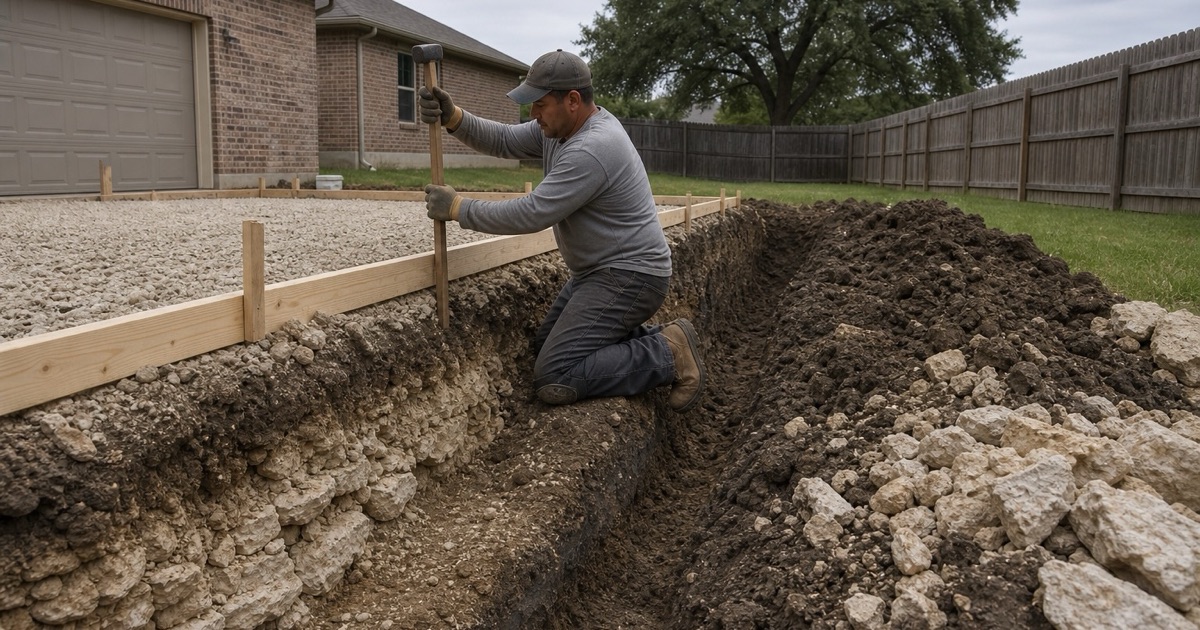
Where limestone comes up to meet the forms
The downtown map unit is 85 percent Eckrant, but it also carries 8 percent Georgetown with indurated limestone at 68 centimeters and 7 percent Doss with weakly coherent bedrock at 36 centimeters — three refusal depths inside a single map unit, which is what a crew finds opening a trench here.
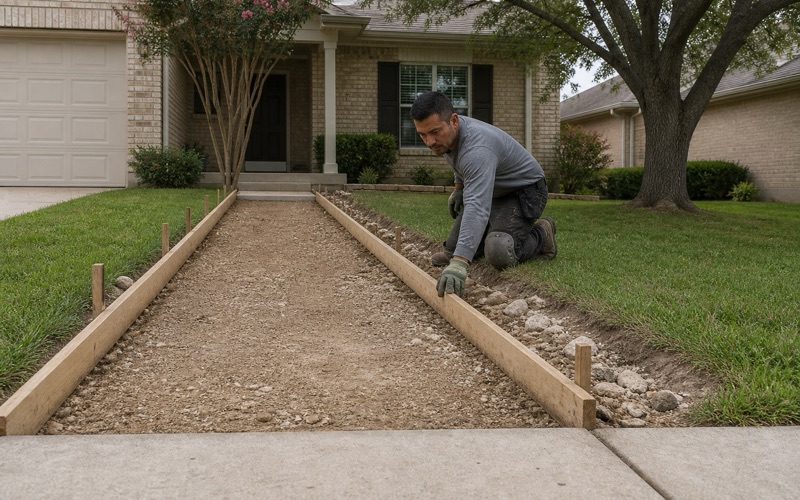
The failure mode here is a slab bearing partly on rock and partly on caliche or reworked fill, because stiff support and soft support move at different rates. We keep bearing uniform, cut flexible base to a consistent thickness rather than a consistent elevation, use isolation joints where a new pour meets anything already fixed in place, and set dowel baskets across a drive-lane construction joint so the two sides stay level rather than stepping.
Where the clay runs deep
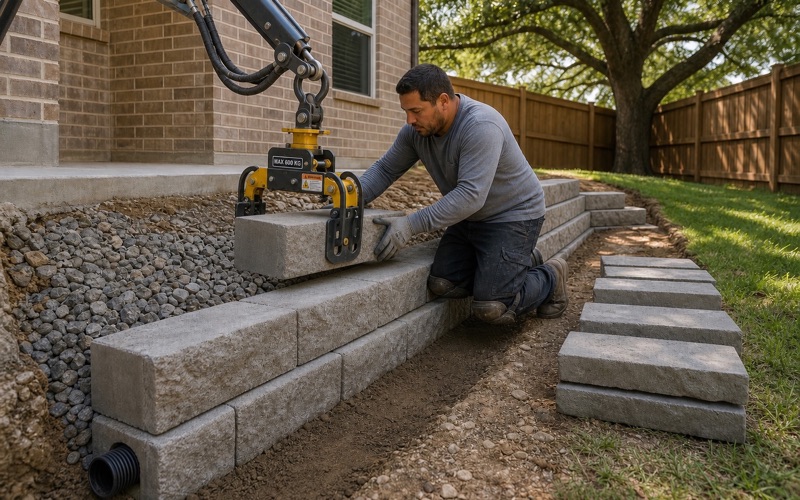
On the southwest side the answer is not excavation but movement control: void form or carton form under grade beams so swelling clay has somewhere to go, a vapor retarder meeting ASTM E1745 under interior slabs, and post-tensioned slab-on-ground with unbonded single strand tendons detailed to PTI DC10.1 where a structural slab is the right call.
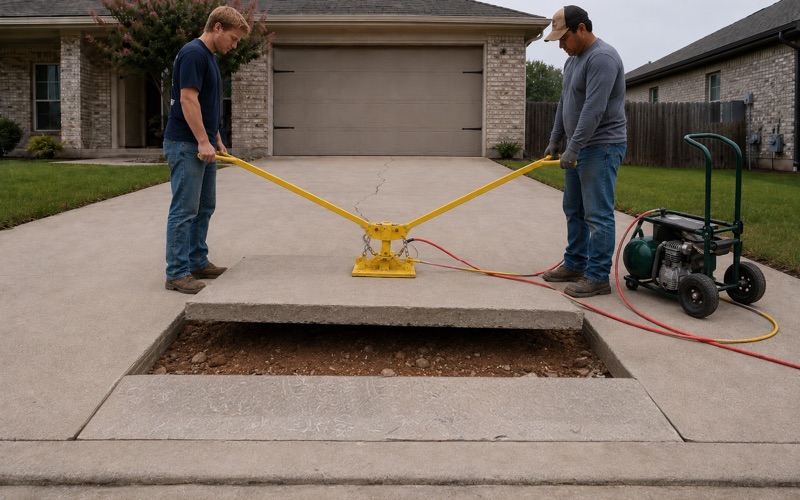
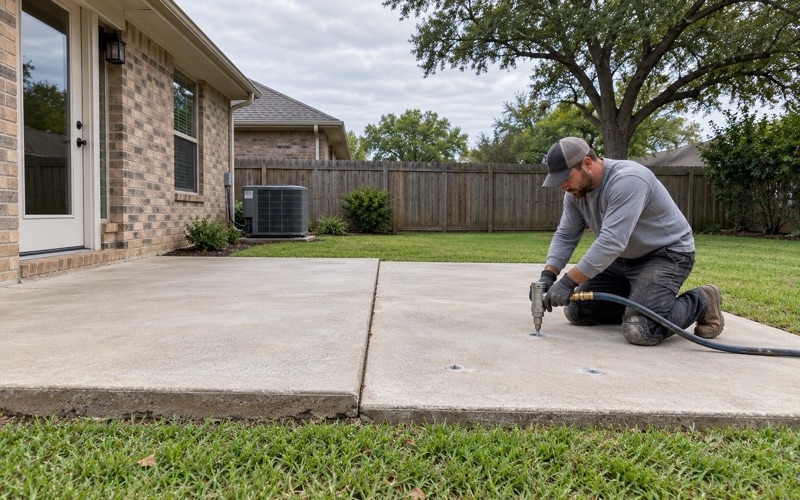
Nearly every residential slab poured in this part of Central Texas since the 1990s is post-tensioned, so we locate tendons before we cut, core or anchor through one; a strand released by a careless sawcut is a repair nobody budgeted for. On a driveway or patio that has settled but is otherwise sound, we quote polyurethane foam injection against full replacement with real numbers on both, because lifting sound concrete costs a fraction of tearing it out.
Compaction here is keyed to the plasticity index
Standard Specification Item RR 201, Table 1, sets three bands: 98 to 105 percent of maximum dry density with no moisture requirement below plasticity index 15; 98 to 102 percent at optimum moisture plus 3 percent from 15 to 35; and 95 to 100 percent at the same moisture above 35. On measured values the west and downtown sides land in the middle band and the southwest and northeast sides in the top one.
The same item requires scarifying and compacting the top 8 inches to uniform moisture and density, correcting grade deviations greater than half an inch in 10 feet, and proof rolling before base is placed, with extra density tests wherever the subgrade material changes. That last clause is the fault zone written as a testing requirement.
Pricing site prep when the ground changes across town
The permit desk, and the clock attached to it
Building permits run through Planning and Development Services, Building Inspection Division at 301 W. Bagdad Avenue Suite 100, 512-218-5550, and everything is applied for, paid and inspected through the city’s Permit Portal. The city runs a strict one-permit system: the general contractor and every relevant subcontractor must accept their assignment in the portal before a permit issues. Review takes roughly 30 business days, expedited review is not available, and a permit goes invalid if work has not started within six months.
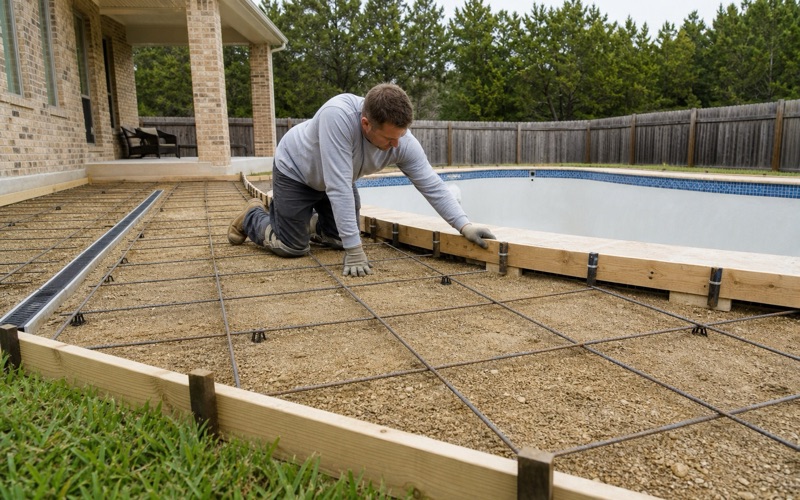
Inspections must be requested by 4:00 p.m. for the following business day and are performed Monday through Friday between 8:00 a.m. and 3:00 p.m., with two of each type included in the fee and $75 for a third. Fees for outdoor work are priced by what sits on the concrete rather than by area: $125 for an uncovered patio without electrical or plumbing, $200 covered, $300 with either. We build that schedule into the quote so the permit line is not a surprise.
Work that touches the street
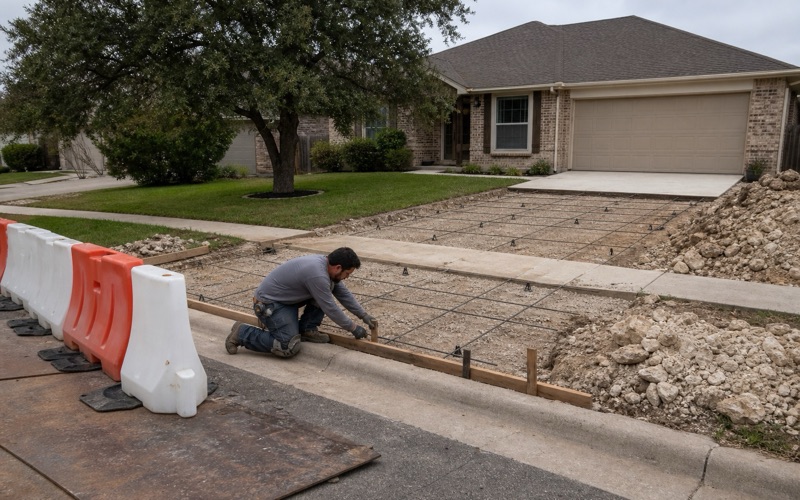
Right-of-way, street cut and driveway approach permits come from the Transportation Division at 3400 Sunrise Road, 512-218-7044, which no longer takes applications by email. A street cut permit is required for any work that will cut, break or otherwise damage a public street: contractor and subcontractor registration, a $1,000,000 certificate of insurance on file, a $2,000 surety bond with the city, a location sketch and a fee of $50 residential or $200 commercial. The review window is 30 days excluding weekends and holidays, and it resets when corrections are submitted — which is why we start that paperwork before we schedule the pour, not after.
Aquifer status is a per-address question here. A 20-point grid inside the city polygon returned 7 points in the Edwards Aquifer recharge zone on the west side, 6 in the transition zone through the center and 7 outside any regulated Edwards zone on the east. We check where a lot falls before quoting new flatwork, because the regulatory path for a commercial site differs on either side of that line.
Driveways are classified, not described
Transportation Criteria Manual Section 5.2 defines a Type I approach as concrete serving a one- or two-family residence, Type II as concrete serving anything else, and Type III as a temporary asphalt approach where the roadway is not yet built to permanent line and grade. Table 5-1 puts single-family width at 12 feet minimum, 18 desirable and 25 maximum, curb return radius between 5 and 10 feet, one driveway per property unless a circular drive is approved, and 50 feet from an intersecting street.
Grades cap at 10 percent residential and 7 percent commercial, and where the approach crosses a sidewalk or accessible route the grade may not exceed 2 percent over a throat of at least 3 feet across the full width. Two-way approaches meet the street at 80 to 90 degrees and may not exceed 70 percent of the roadway frontage. Zoning and Development Code Sec. 4-48 goes further and restricts residential driveways to local and local collector streets, with corner and double-frontage lots taking the lesser classification.
Materials, joints and finish the specifications actually name
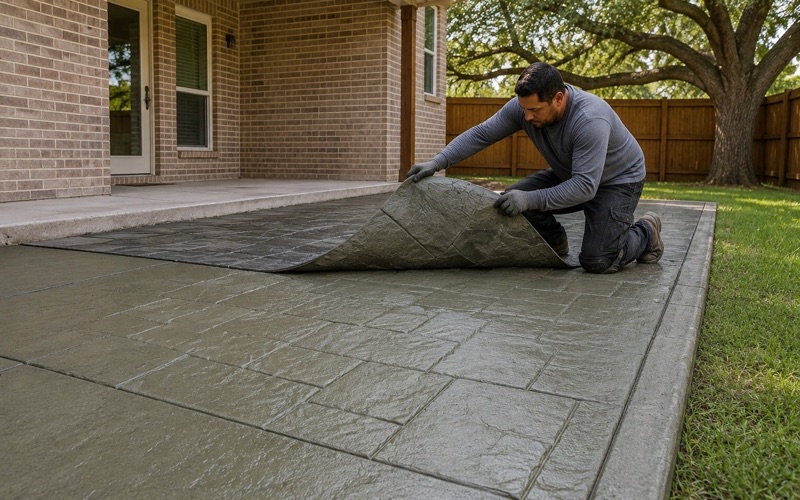
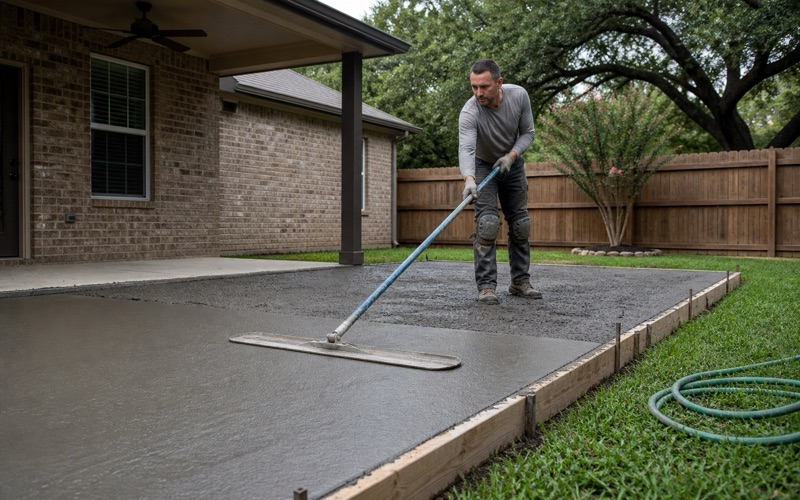
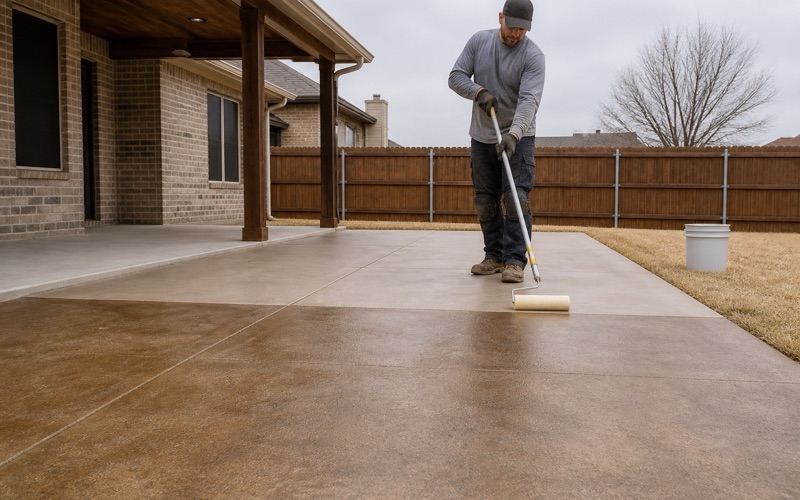
Item RR 436 requires Class A concrete with Grade 60 or better reinforcement and states plainly that welded wire fabric shall not be used for concrete reinforcement, though approved DMS-4550 fibers may replace reinforcing steel. Jointing is specified rather than left to habit: expansion joint material half an inch thick for the full depth, weakened-plane joints on 10-foot centers a quarter inch wide and three quarters of an inch deep, a medium broom finish, membrane curing compound under DMS-4650 or wet burlap, and traffic kept off for at least 72 hours. Parking lot bumper curbs under Item RR 439 must be precast; cast-in-place wheel stops are not accepted.
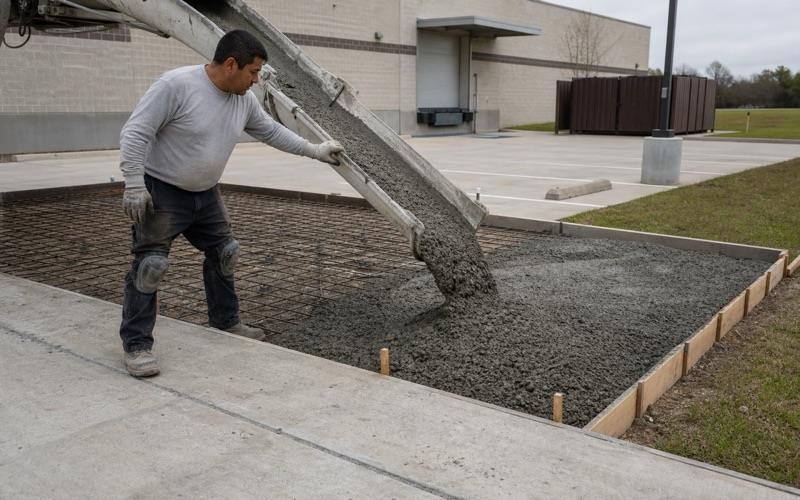
Those rules travel well onto private work, and we build to them by default on commercial pads, fire lanes, dock aprons and the housekeeping, generator and transformer pads that come with them. In summer we schedule around the temperature of the mix rather than the air, because the state highway specification starts the discharge clock once the concrete itself reaches ninety degrees.
- 20+ Years Pouring Concrete
- Registered & Insured
- We Pour Our Own Jobs