Cedar Park Elite Concrete is a concrete contractor working in Santa Rita Ranch, and after more than twenty years of pouring slabs and flatwork we price the ground before we price the concrete. On this side of Williamson County that is not a formality. The dirt under a Santa Rita Ranch lot decides the reinforcing, the joint layout, the cure schedule and, more often than not, the number at the bottom of the estimate.
Most of what we are asked for here is additive rather than corrective. The builder already delivered the driveway, the lead walk, the street sidewalk and a covered rear patio along with the house, so the work that reaches us is the extended patio slab, the outdoor kitchen apron, the fire-pit pad, the pool deck poured after closing, the side-yard walk, the sport court or playscape pad, and the shop or RV parking slab.
Two questions decide every one of those jobs, and neither answer is the one homeowners expect. What sits under the slab is not uniform across the community, and the body that has to approve the work is not the county.
Deep clay under brand-new construction
Fairlie clay covers roughly 47 percent of the Santa Rita Ranch census designated place across its 0-to-1 and 1-to-2 percent slope phases. It is a fine, montmorillonitic, thermic Udic Haplusterts, which in working terms is a vertisol: a soil that swells when it takes on water and shrinks when it gives that water back.
The numbers are the part worth quoting. Fairlie carries a representative plasticity index of 35 in the top 20 centimeters and 41 from 20 to 117 centimeters, clay content between 42.5 and 50 percent, and linear extensibility of 7.5 percent. A plasticity index above 15 is the value commonly used as the expansive-soil threshold in foundation design, and every dominant soil mapped across this community clears it comfortably.
The layer a shallow hole never shows
Georgetown stony clay loam covers roughly another 28 percent, and it behaves as two different soils depending on how deep you dig. The surface horizon runs about 30 percent clay with a plasticity index of 23 and linear extensibility near 2.5 percent, which feels like reasonable ground for a patio.
Below that, from roughly 17 to 89 centimeters, the subsoil is 70 percent clay with a plasticity index of 48 and linear extensibility of 8.5 percent. A shallow excavation reads as benign and a deeper one does not. That is why we open the ground to the depth we actually intend to build to rather than judging a slab from a spade’s worth of topsoil.
What that changes about the pour
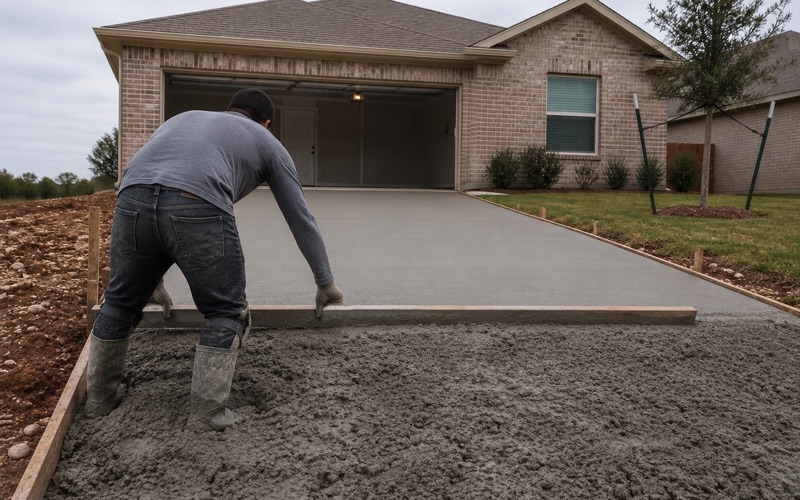
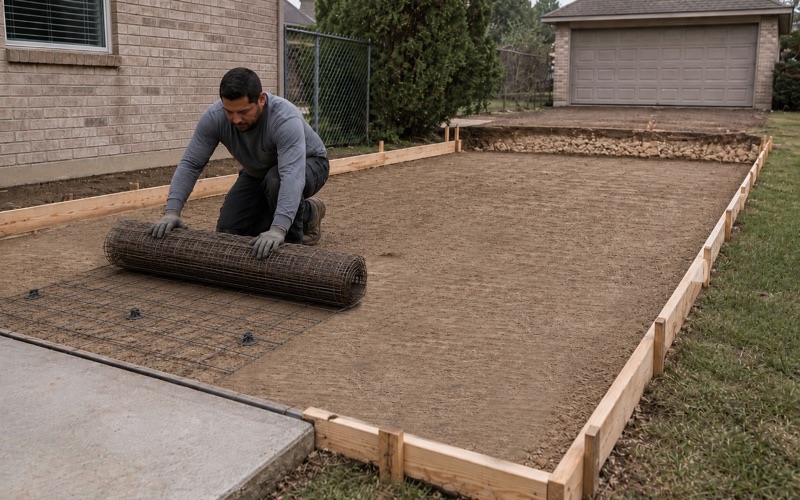
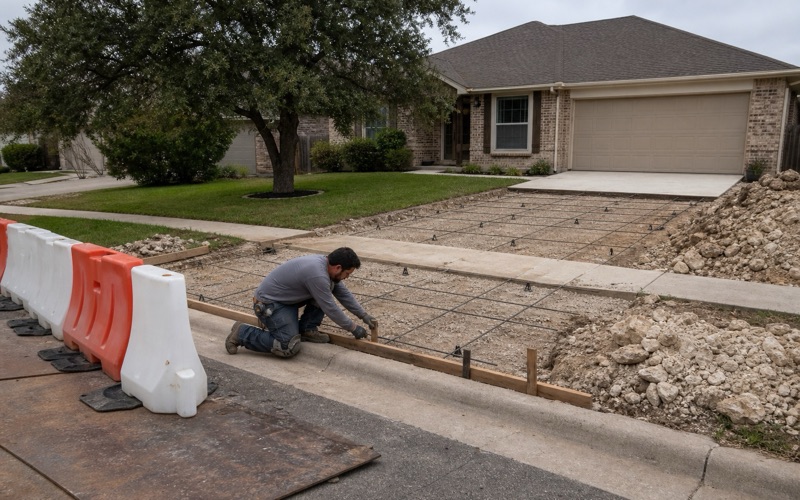
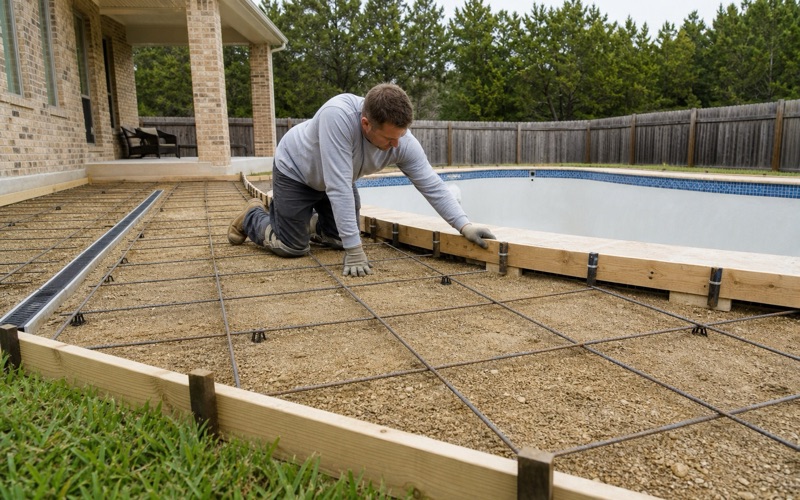
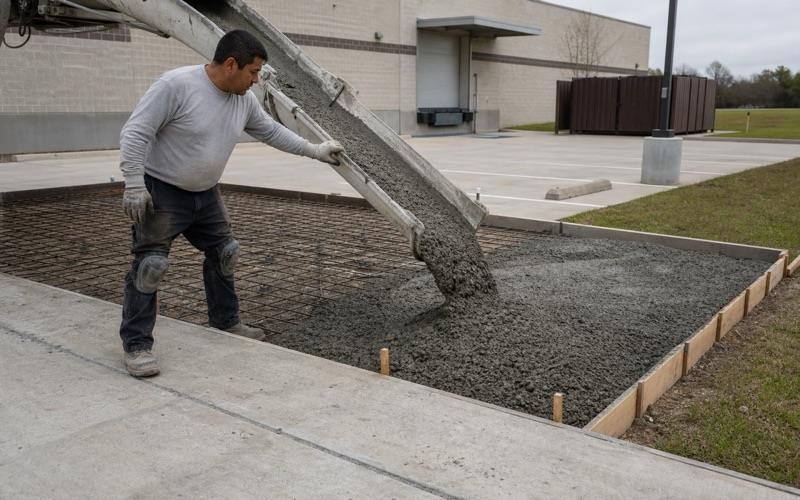
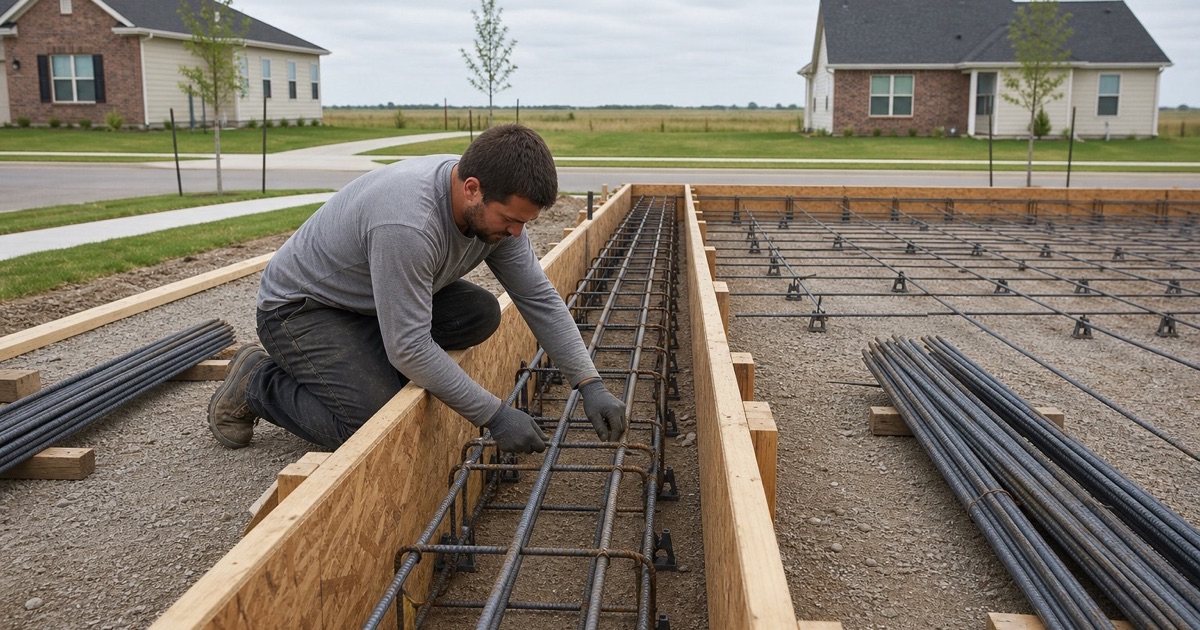
Potential vertical rise on ground like this is what drives the detailing, so we build a stiffened section rather than a nominal four inches with a sheet of mesh floated somewhere near the middle. That means subgrade compaction over a moisture-conditioned base, a vapor retarder meeting ASTM E1745 where the slab adjoins conditioned space, welded wire reinforcement or bar carried on rebar chairs instead of pulled up by hand mid-pour, and isolation joints wherever new flatwork meets the house or a covered-patio column.
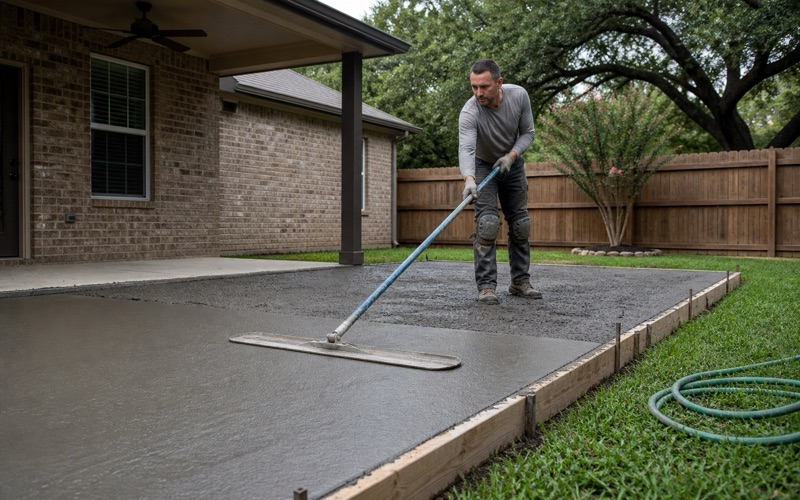
Joint spacing gets tighter on this soil, not looser. We sawcut control joints early and deep enough to actually relieve the section, and we hold the water-cement ratio down and the slump honest rather than adding water at the truck to make placement easier. A wet mix on expansive clay buys an easy morning and a map of cracks by the second summer.
Looking for concrete-contractor closer to Lago Vista? See Concrete-Contractor in Lago Vista.
What a county that issues no building permit does inspect
Williamson County has not adopted a residential building code for its unincorporated area, has no zoning authority there, and does not issue certificates of occupancy. A patio slab, a walkway or a pool deck at Santa Rita Ranch draws no county building permit and no county inspection.
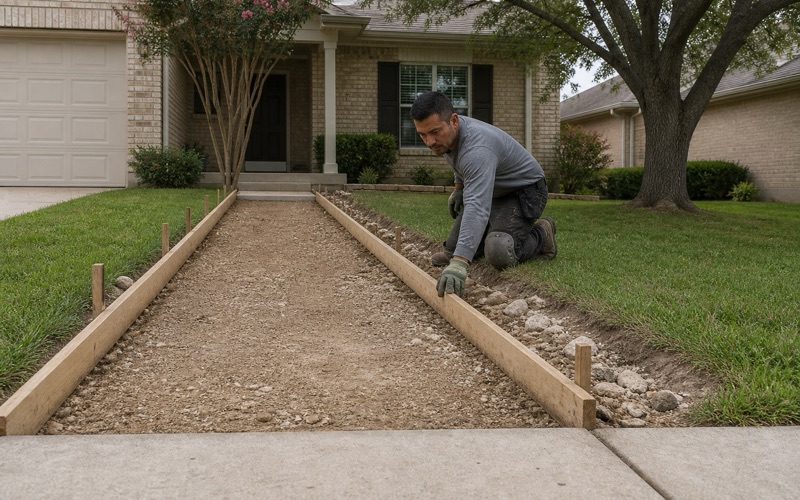
We say that plainly, because the alternative is billing for a permit that does not exist. It also means no building official is going to look at your reinforcing before it disappears under concrete, so the pre-pour check that matters is the one we run ourselves, with the homeowner welcome to stand in the forms and see it.
Texas issues no state license for a concrete contractor either. The Texas Department of Licensing and Regulation’s own list of 205 license types contains no concrete, flatwork, masonry, paving or general residential contractor category; the only contractor licenses on it are electrical, electrical sign, appliance installer and A/C. There is nothing here for a homeowner to look up, which is why we would rather show you the mix design, the joint plan and the submittal package than a credential that does not exist.
What the county does permit
What the county regulates is the ground and the road. That means a driveway or culvert permit from the Williamson County Road and Bridge Division, a Certificate of Compliance, a Floodplain Development Permit where regulated floodplain sits on or adjacent to the work, and site plan and utility permits. All of them are filed through MyGovernmentOnline with Williamson County selected as the jurisdiction.
Where a recorded subdivision plat already carries a Defacto Certificate of Compliance in its plat notes, a separate Certificate of Compliance application may not be required. Reading the plat notes first takes an afternoon; filing an application nobody needed takes considerably longer.
The Santa Rita Reviewer
The real gate on residential concrete work here is private rather than public. The Santa Rita Master Community design guidelines run improvements through a three-stage plan review plus a Final Plan Application, and no improvement may commence until that application has been submitted and executed by the body the documents call the Santa Rita Reviewer, which will attempt to review submittals within 30 days.
Stage 2 asks for a site plan showing the location of and the material to be used for driveways, sidewalks, patios, decks and any ancillary improvements, which is to say the exact scope of a flatwork job. Pools, spas, hot tubs, playscapes, trampolines and sport courts are each named individually as needing written approval before construction or placement begins.
The constraint that most often decides how far back an extended patio can actually be poured is the 10-foot rear setback measured from the rear boundary line of the lot, inside which no improvement may be built without the Reviewer’s written approval. We would far rather find that on the plat than on the morning the forms are set.
Post-tensioned slabs, and cutting into one
Post-tensioned slab-on-ground is the norm on soil with this plasticity rather than the exception, and the housing stock here is new enough that it is effectively universal. Of the 2,192 housing units in the community, 1,033 were built in 2020 or later and another 1,090 between 2010 and 2019, with zero units reported in every decade row before 1980.
That matters the moment anyone cuts, cores or anchors through a slab. An unbonded single strand tendon stays under load for the life of the structure, and releasing one is not a repair, it is a structural event. We locate tendons before a saw blade or a core bit touches concrete, and we work to the PTI DC10.1 framework for slabs on expansive soils rather than reading a tendon layout off a builder’s plan sheet and hoping it was placed as drawn.
Tying new flatwork to an existing slab
The right answer is usually not to tie in at all. New patio and pool-deck slabs get an isolation joint against the house rather than dowels driven into a post-tensioned edge beam, so the two are free to move independently, which on ground with this linear extensibility they are going to do regardless of what we prefer.
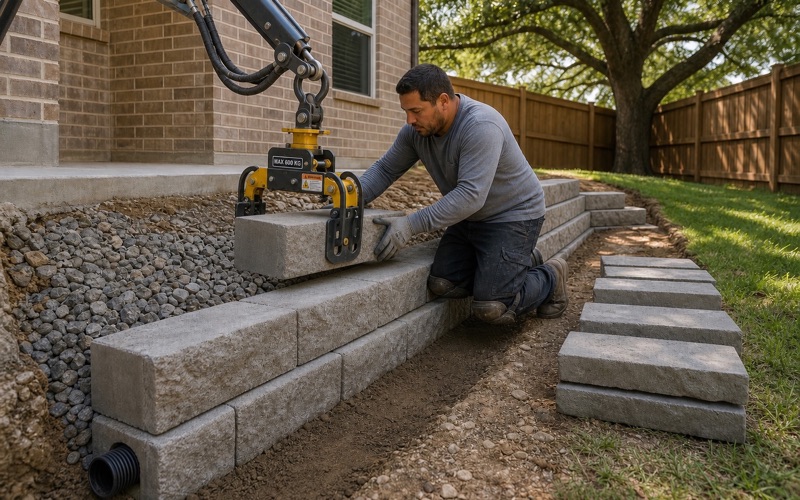
Where a doweled connection is genuinely called for, it goes into a location we have confirmed is clear, using a dowel basket set in the forms rather than bars drilled in afterward. Void form and carton form under a grade beam do the same job from underneath: they give swelling clay somewhere to go that is not upward against the structure.
Lifting against replacing
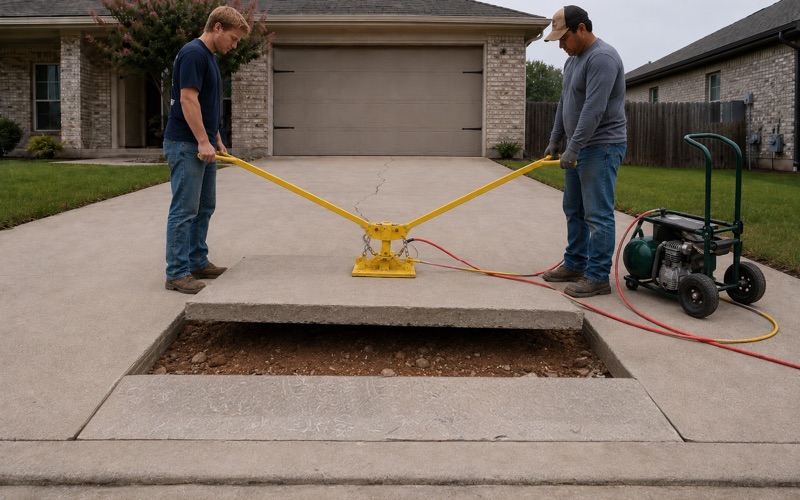
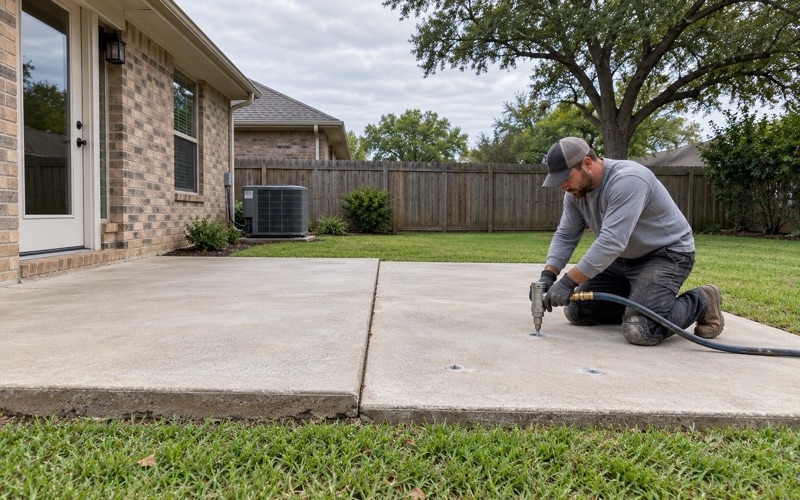
When an older slab has moved, we price leveling against replacement with real numbers and tell you which one your slab actually needs. Polyurethane foam injection lifts a panel that is still structurally sound for a fraction of a tear-out, and diamond grinding can take a trip hazard off a joint without touching the slab at all.
A panel cracked through in more than one direction, or one that has lost its subgrade support across most of its area, is not a candidate for slabjacking, and we will say so rather than sell a lift that fails again in two seasons. Partial-depth repair and joint resealing sit between the two extremes and are worth pricing honestly alongside them.
Approaches, walks and the covenant that draws them
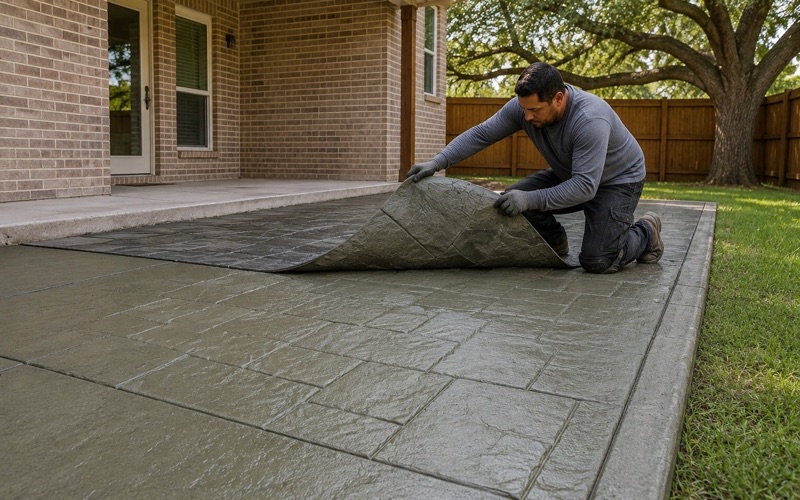
The recorded design guidelines specify the driveway in more detail than many municipal codes manage. A brushed concrete finish is required and asphalt is prohibited outright, the minimum width is 12 feet, the path width may not exceed 18 feet within 5 feet of the curb, the turnout area is capped at 30 feet wide, and each lot gets one driveway access.
Clearances are written in as well: at least 1 foot from adjacent property lines, and 2.5 feet where side-entry garages face one another across a shared line. Where a drive sits significantly above finished grade, the exposed sides have to be underpinned and parged rather than left open.
Sidewalk geometry and the accessibility detail
Sidewalks are fixed by covenant at 4 feet wide on neighborhood streets and 6 feet on collectors, set adjacent to the back of the curb and compliant with the Texas Accessibility Standards. Pedestrian sidewalks must be brushed concrete; the lead walk connecting that sidewalk to the house may be brushed concrete or exposed aggregate, and each owner builds the sidewalk in conjunction with construction of the residence.
Where a driveway conflicts with a pedestrian walk, the guidelines require the curb to be saw cut and a handicap ramp installed to Texas Department of Licensing and Regulation Architectural Barriers, Texas Accessibility Standards and ADA requirements. In practice that is a curb ramp carrying a detectable warning surface of truncated domes, specified inside a private residential covenant rather than a public code, and we build it to the standard the covenant cites.
Drainage stays on the lot
Drainage is the owner’s responsibility by covenant, which makes it ours by contract. There may be no interference with established drainage patterns unless the alternative is certified by a professional engineer and approved in advance, and each owner is solely responsible for correcting any change in water flow caused by improvements built on the lot.
No area drain may extend through the curb; the opening has to sit behind the curb, inside the lot. Pool backwash carries the same shape of rule, contained on the lot rather than discharged to a street, an adjoining lot or a drainage easement, and not into the sanitary sewer without the utility district operator’s advance written approval. Eight active Williamson County municipal utility districts overlap this community, so the operator whose sign-off a pool deck tie-in needs changes from one section to the next.
Working hours, and the exception written for concrete
Covenant construction hours run Monday through Friday from 7:00 a.m. until 7:00 p.m. and Saturdays and Sundays from 9:00 a.m. until 6:00 p.m., with no work on New Year’s Day, Easter, Memorial Day, July 4th, Labor Day, Thanksgiving Day or Christmas Day. The guidelines then carve out exactly one trade-specific exception: waivers may be given for the pouring of concrete slabs during the summer months.
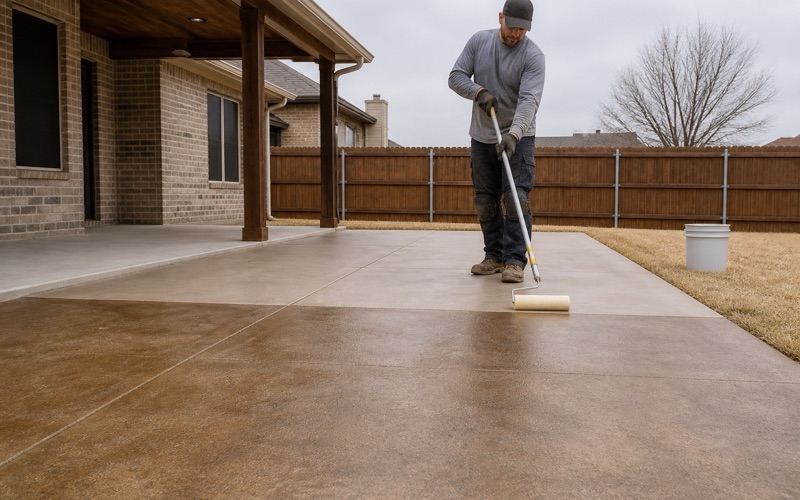
That exception exists because of the temperature of the mix, not the comfort of the crew. We plan summer pours around the concrete’s own temperature rather than the air temperature, size the load so a small pad does not sit in the drum waiting, and get a curing compound or a wet cure onto the surface immediately instead of letting a hot slab give its water back to the sky. On this clay, a slab that cures properly in its first week is doing most of the work of lasting.
- 20+ Years Pouring Concrete
- Registered & Insured
- We Pour Our Own Jobs